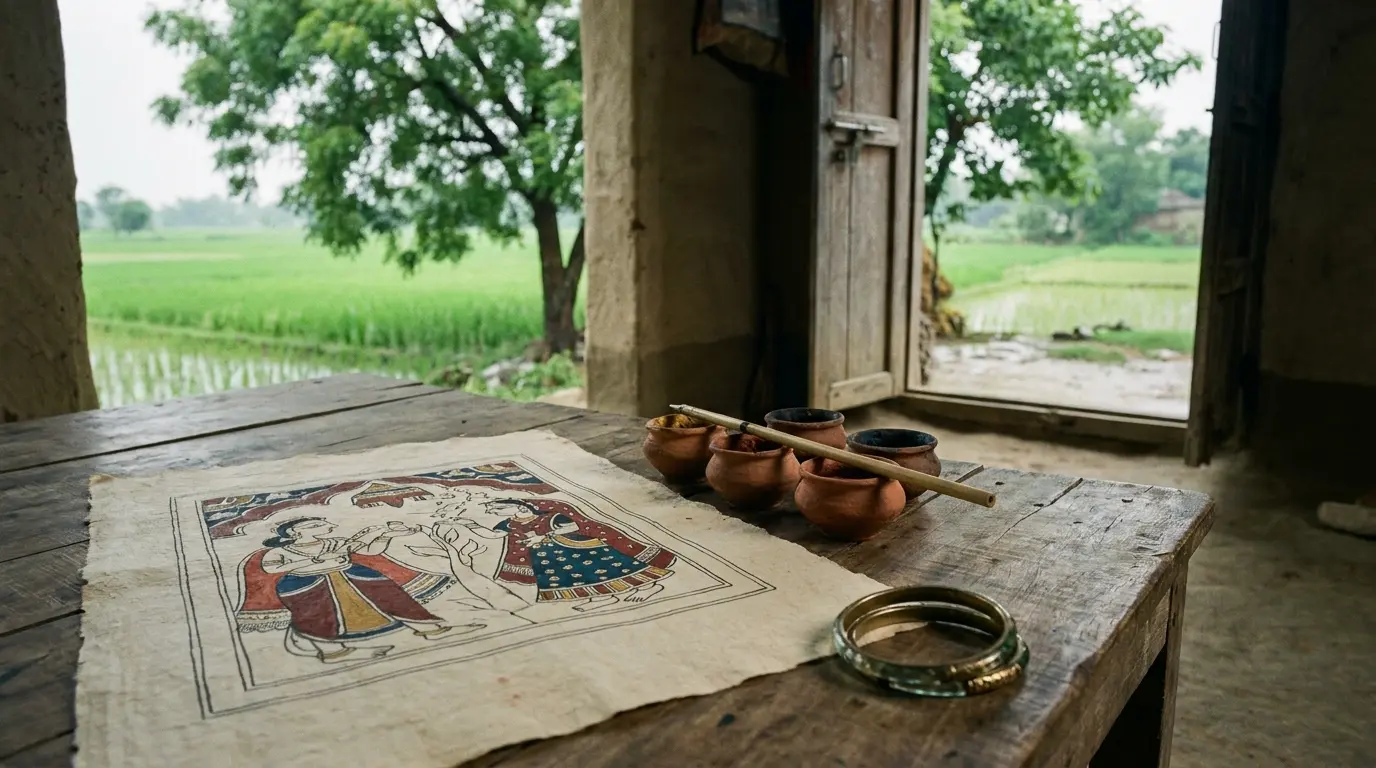
The verandah at Karpoori Devi's house in Jitwarpur faces east, which is the only direction it can face — the village is built along a single dirt road and her house is on the side that catches the morning. Mithila in October still has the green of late monsoon at the edges, paddy on three sides, a single neem in the courtyard. She paints from about seven in the morning until the light goes flat at noon, and again from three until the brass bowls are brought in for dinner. The painting in front of her on the day we visited was a Krishna and Radha she had been working on for eleven days. She thought it would take three more.
The first thing to know about a Madhubani painting is that almost none of it is ever bought from a shop. The paper she paints on is made twenty kilometres away in a small mill that still beats cotton rag by hand, then dries it on bamboo screens. The paper is thicker than cartridge, slightly cream, and has a faint grain that the brush picks up. She buys it in stacks of fifty and the stack lasts her four months.
The pigments are the part that takes the longest to explain. There are four she uses every day, and a few more she keeps for special pieces. The red is from henna leaves crushed and steeped in well water — the same dye, more or less, that women apply to their hands at weddings. The black is lampblack, soot caught above an oil lamp on the underside of a clay plate, then ground with a drop of gum arabic. The yellow is turmeric, the same one her daughter cooks with, mixed with a little neem oil so it does not crack as it dries. The blue is indigo, fermented in a clay pot for weeks, and it is the only pigment she pays cash for now — the cultivation of indigo around Mithila has thinned to almost nothing in her lifetime.
The brushes are not brushes. The line work — the doubled outlines that give a Madhubani painting its distinctive look — is done with a bamboo stylus, a thin twig of bamboo split at one end and chewed soft, the way a child might chew a pencil. Karpoori Devi has been chewing the same kind of bamboo for fifty-three years. The fill is done with a small cotton swab wrapped around a stick. There is no Western brush in the house. We checked.
The doubled-line convention — the most recognisable feature of the form — is not a stylistic choice. It is a structural one. The first line is drawn freehand, in a single confident stroke. The second is drawn parallel to it, about two millimetres outside, and it carries the colour. The space between the two lines is left white. The eye reads this as a glow, an outline of light around every figure, and it is the reason a good Madhubani painting seems to emit rather than reflect. There is no shading anywhere in the painting. Depth is suggested by the density of fill and by the layering of motifs — fish, lotus, peacock, sun, moon — that fill every available surface. Madhubani painters have a phrase for empty space on a panel. They call it the place where work has not yet happened. They do not leave any.
This is also why no two Madhubani paintings are identical. The composition is from memory and from convention — the painter knows what figures belong in a Krishna-Radha and which do not — but the placement is freehand, the line is freehand, the proportion is freehand, and every painter has a slightly different rhythm. Karpoori Devi's peacocks are tall and slim. Her sister-in-law's, two doors down, are squatter and have a different tail. We have seen Karpoori Devi paint the same theme four times in three years, and each one is its own painting.
The painting we commissioned that day was a Tree of Life — Kalpavriksha — for a buyer in Bangalore who had asked for one with seven birds, one for each of her grandchildren. Karpoori Devi listened, asked which birds, and then said koel, peacock, parrot, sparrow, crane, dove, and one I will choose. The buyer agreed without asking which one. We think the painter will paint a kingfisher, because there is a small lake behind the village and there is always a kingfisher on the wire above it.
The painting will take her about five weeks. We will photograph it at the half-built stage and send those photographs to the buyer — not because we think she needs convincing, but because the half-built stage of a Madhubani painting is one of the most beautiful things you will ever see. The outlines are all there, the doubled lines holding their slight glow, and the colour has begun in only some of the figures. It looks like a courtyard at dusk when half the lamps have been lit.
A buyer can ask the painter to depict almost anything. Krishna and Radha. A wedding. A festival scene. A Kohbar — the marriage chamber painting — for a wedding gift. Trees, fish, the sun and moon together (which is a marriage motif, in case you did not know). The form has a vocabulary, and the painter will tell you what is and is not within it. What you cannot ask for is something Karpoori Devi has not painted before. She is gracious and she will try. But the work she does best is the work that has been done in Mithila for centuries, and the version of it she has been refining for fifty-three years.