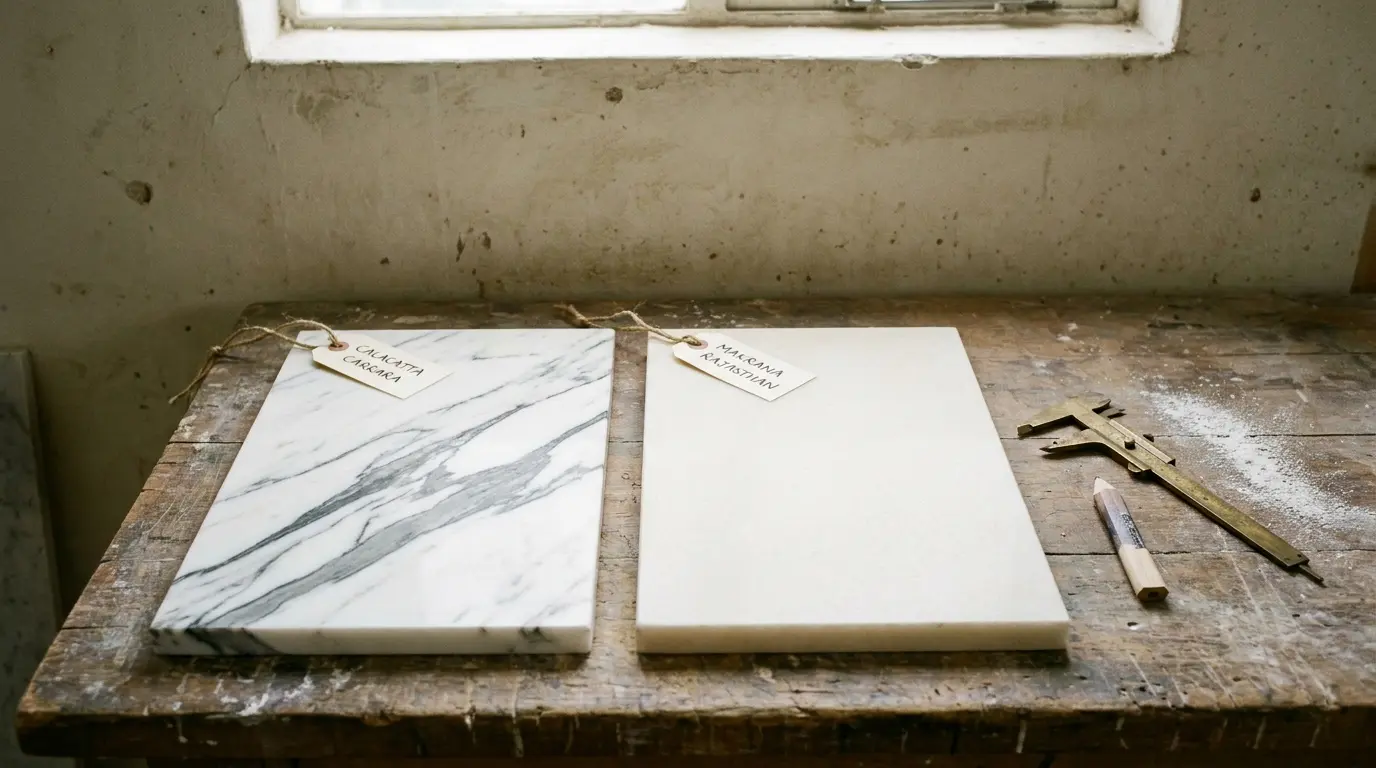
Two slabs arrived at our workshop in Kishangarh on the same Tuesday. The first was a Calacatta from a quarry above Carrara, in northern Tuscany — a buyer in Mumbai had ordered it for a dining table. The second was a block of Makrana white from a quarry an hour from where we were standing — a different buyer, in Goa, had ordered it for a bath. The crates were stacked next to each other in the yard, and for the first morning before the chalk lines went on, the two slabs sat side by side under the same November sun. We watched a few of our cutters walk past, touch each one, and walk on. They knew, without being told, which was which.
There is a tendency in our industry to talk about Italian marble as though it is better than Indian marble. This is wrong. They are different stones, formed under different pressures over different times, and the right one to use depends entirely on what you are using it for. Below is what we have learned, working with both for many years, in plain language.
The four whites you will hear most
The first thing to know is that white marble is not one thing. It is a category that contains stones that behave very differently. The four whites we work with most are Calacatta, Statuario, Carrara white (all from Italy) and Makrana white (from Rajasthan).
Calacatta is the dramatic one. It is white-cream — never a true cool white — with thick, swooping veins that range from charcoal to gold. Two slabs from the same block almost always book-match into a single mirrored image, which is why it is the marble of choice for a statement dining table or a dramatic wall. It is dense, it polishes to a high gloss, and it is expensive — figure on three to four times the price of Makrana, before fabrication.
Statuario is also from the Carrara region but from different quarries — its white is whiter than Calacatta's and its veining is finer, more linear. It is the marble of classical sculpture; Michelangelo cut his David from a Statuario block. For a bathroom or a small panel where you want a quieter dignity, this is the one.
Carrara white is the workhorse Italian — soft white, fine grey veining, almost always a "cloudy" character rather than a sharply linear one. It is what most people are picturing when they say Italian marble and have not yet seen the others. It is significantly less expensive than Calacatta or Statuario, and for a kitchen counter or a fireplace surround it is often the most sensible choice.
Makrana white is the great Indian white, and it is not a substitute for Carrara — it is its own stone with its own character. It is warmer, slightly creamy, more uniform than the Italians, with a fine grain and a low-shimmer finish that holds light beautifully. The Taj Mahal is built from it. It is denser than Carrara white, takes a polish slowly but holds it longer, and it weathers to a soft patina that the Italian marbles do not develop in quite the same way. Where it is right is in spaces where you want stillness rather than drama — a bath, a temple, a low console. Where it is wrong is when the room needs an event, and the marble is the event.
Beyond the whites
A few other stones come up often enough to mention.
Indian green marble — quarried near Udaipur — is a deep mossy green with darker veins, and it is the right stone for an offering vessel or a basin where the colour is meant to ground the room. It is harder than the whites, takes detail well, and looks superb against brass.
Black Galaxy is technically a granite, not a marble — quarried in Andhra Pradesh, deep black with a scatter of small bronze flecks that catch the light like a long-exposure photograph of stars. It is a much harder stone than any marble, harder to carve and almost impossible to inlay, but for a kitchen island or a vanity counter where you want absolute toughness and a touch of theatre, there is nothing else like it.
Kishangarh travertine is a softer, more porous Indian stone — warm cream with a natural pitting that some buyers fill and polish, others leave open. It is the right stone for a wall cladding or an outdoor bench where the texture is meant to be felt as much as seen.
How to choose
When buyers ask us how to choose, the conversation is usually about three things: the room, the light, and the budget.
The room first. Is the marble meant to be noticed — a dining table, a fireplace, a bath that anchors the bathroom? A dramatic stone, Calacatta or a veined Indian green, will repay the investment. Is the marble a quiet surface meant to live with paintings, fabric and other busy detail? A quieter stone — Makrana, Carrara, Statuario — will hold the room together rather than fight for it.
The light second. Cool north-facing rooms suit cooler whites — Statuario, Carrara — because warm whites read greyish under blue light. Warm south or west-facing rooms suit warmer whites — Makrana, Calacatta — because cool whites read sterile under golden light. We have made this mistake on our own projects and we have learned to ask about the windows before the budget.
The budget third, and honestly. A Calacatta dining table from a book-matched block, fabricated and installed, is five to nine lakh in 2026 rupees, depending on size. The same table in Makrana white is closer to one and a half to two and a half lakh. Neither is better. They are different choices, and the conversation we want to have with you is the one that ends with the right stone in the right room.
If you ever cannot decide, ask us to send you a small offcut of each, and put them on your floor for a week. The room will tell you which one belongs.