A buyer wrote to us last month with a single question. He had picked the dining table from our Stone collection — the book-matched Calacatta — and he wanted to know how soon it could ship. He had a delivery in mind. The flat was in Powai. The wall was painted. The chairs were ordered.
We told him eight to ten weeks. He said thank you for your honesty, and then he asked the question we have learned to expect. Why don't you just keep one in stock?
The instinct behind that question is not unreasonable. It is the inheritance of a century of retail logic — the idea that a serious shop is one that can put a thing into your car the day you walk in, and that anything else is an inconvenience to be apologised for. For a sofa from a factory in Vietnam, or a lamp from a warehouse in Noida, this logic is sound. It is not sound for our work.
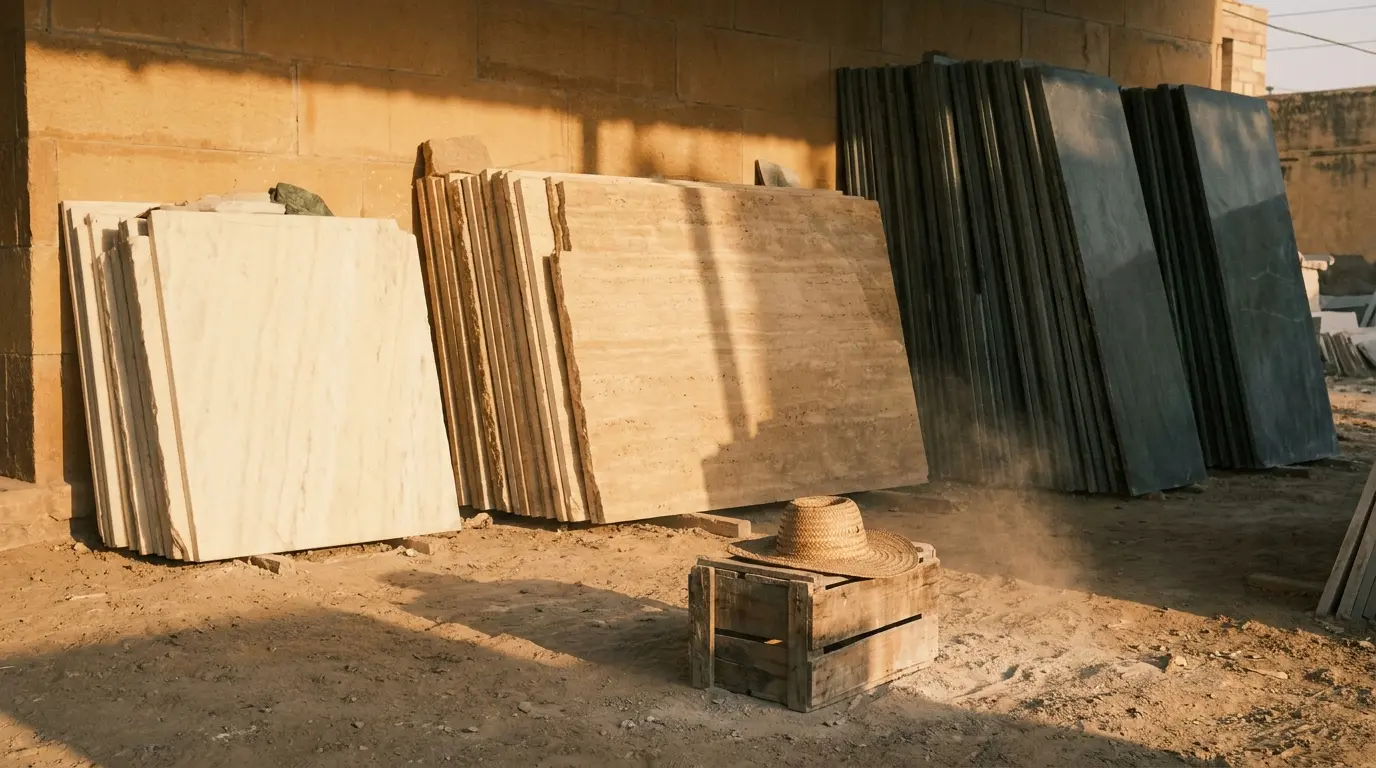
The piece he had chosen begins as a single block of Calacatta in a quarry above Carrara. That block is cut into two slabs that mirror each other along the vein — what the trade calls book-matched. Those slabs travel by sea to Mumbai, then by road to a workshop in Kishangarh where they sit in the yard for a week, acclimatising to the heat. Only then does the master cutter take a chalk and draw the first line. The brass cradle is fabricated in parallel, in a smaller foundry forty minutes away. The two come together, are dry-fit, are taken apart, are finished, are reassembled. The whole sequence takes eight weeks if nothing goes wrong, and twelve if a slab cracks at the wrong moment. We have learned to plan for both.
To hold one in stock would mean choosing the slab in advance, on a buyer who does not yet exist. It would mean guessing — at the vein character he wants, at the dimensions of his room, at whether his wall is lime-plastered or painted, at whether he eats six or ten. It would mean cutting, finishing and crating a piece that may sit for a year in a warehouse in Bhiwandi while we pay rent on it. Worst of all, it would mean the slab he ends up with is the slab we picked for an imaginary client, not the one he would have picked himself.
There is also the matter of what holding inventory does to the workshops. The yards in Kishangarh, the painting families in Jitwarpur, the mosaic ateliers in Mughalpura — these are not factories with line workers. They are small ateliers, some of them three generations in, where six or eight people might be working on five or six pieces at any given moment. If we order pieces speculatively, we displace the orders of buyers who actually want them. If we order them at the rhythm at which buyers arrive, we keep these workshops steady, paid, and able to plan their year.
So our model is the inverse of retail. We do not hold what we sell. We sell, and then we make. The friction of that — the eight to ten week lead time, the photographs of progress instead of a tracking number, the fact that nothing is available now — is real, and we do not pretend otherwise. We have lost commissions to it. A buyer two months ago needed a console table installed before her parents arrived for Diwali. We could not turn it around in three weeks and we said so. She bought elsewhere. The piece she bought was lacquered MDF with a marble print laminated on top. We hope she enjoys it.
What we offer in exchange for the wait is something a warehouse cannot. A slab chosen by you, photographed before cutting, allocated against your name. A workshop visit if you can travel, or weekly photographs from the floor if you cannot. One person on your line — same name, same WhatsApp number — from quote to install. A piece that is, when it arrives, not a copy of a thing other people have, but the thing itself.
The buyer in Powai paid his deposit. We sent him a photograph of his slab the next week — the veining is dramatic, charcoal on cream, a single dark river running diagonally across both halves. He texted back a single word: perfect. The table will be installed in late July.
This is the bargain. We are slower than the warehouse and we always will be. In return, what arrives at your door is the only one of its kind, and it was made for you, and the workshop that made it ate well that month because you ordered it. We think that is a fair trade. We hope, after eight weeks, you do too.