Journal · Living
Stone in Restaurants: Why Hospitality Tables Outlive Everything Else on the Floor
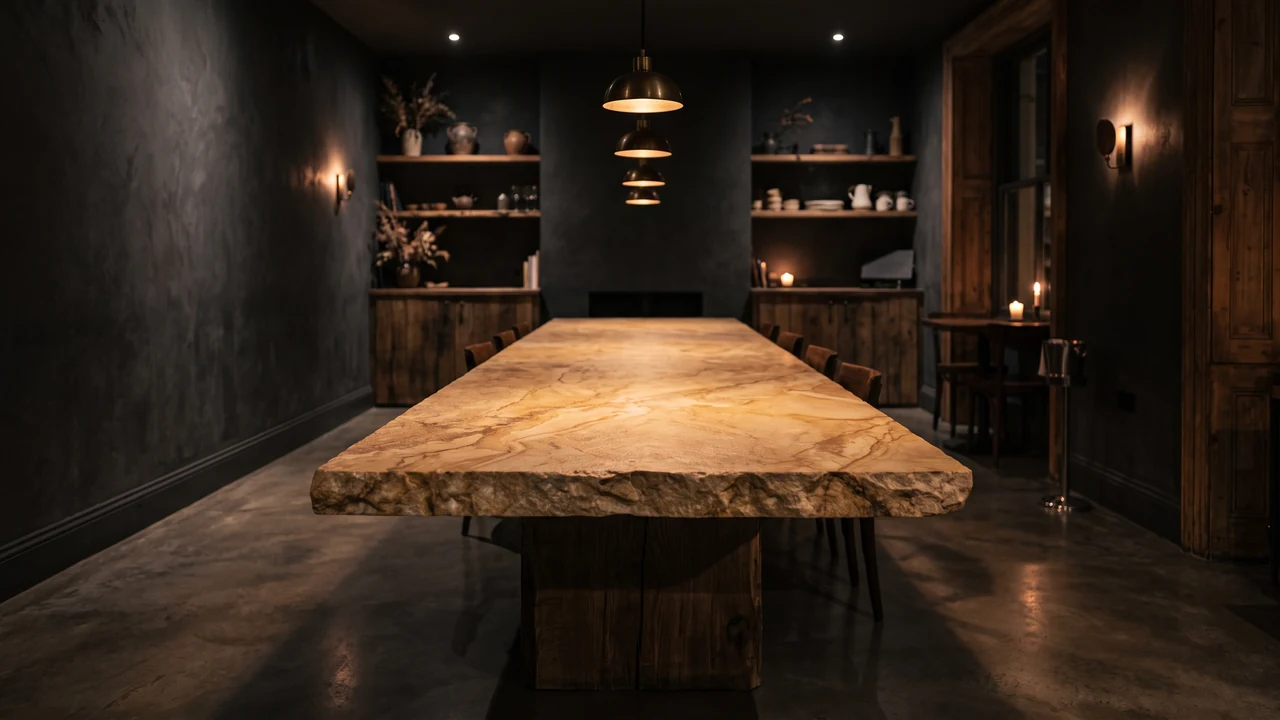
Walk into any restaurant that has traded for a decade and look closely at what has survived. The chairs have been reupholstered, probably twice. The banquettes have been recovered, the pendant lights swapped for whatever the last refit fancied, the timber tops sanded flat where hot plates scorched them and then, eventually, replaced. Kitchens are gutted and rebuilt. Menus change, names change, sometimes the whole concept changes. And in the middle of all that churn, occasionally, sits a table carved from a single block of stone — unmoved, unbothered, looking very much as it did the day it was set down.
That is not sentiment. It is the economics of a hard-working floor, and it is the reason more Indian restaurateurs, hoteliers and hospitality designers are treating stone not as an indulgence but as the one line item that stops being an expense. This piece is an honest look at why — including where stone is the wrong answer, because an atelier that only tells you the good half cannot be trusted with a fit-out.
The churn a restaurant floor actually endures
A dining table in a home might be wiped down twice a day and set with a hot dish at dinner. The same table in a busy restaurant is turned four, five, six times a service. It meets wine and lemon and vinegar, coffee rings and oil, the scrape of cutlery, the daily assault of a cleaning cloth and whatever disinfectant the closing shift favours, and it does all of that hundreds of times a week for years. Most furniture is simply not built for that. Laminate chips at the edge and lifts once water finds the seam. Solid timber is beautiful but moves with Indian humidity, swells, and burns under a hot plate. Veneer, however convincing, is a skin — and skins wear through.
Hospitality interiors know this, which is why so much of a restaurant is designed from the outset to be thrown away. The refresh cycle for a mid-to-upper dining room runs roughly five to seven years, and the budget assumes most of the room will be redone. Stone is the exception that quietly breaks that assumption.
Why stone outlasts the fit-out
A table carved from a single block has no construction to fail. There is no joint to open, no lamination to delaminate, no coating to wear through, no substrate to swell — it is the same material all the way down. A scratch in a laminate is permanent; a scratch in solid stone is surface, and the whole top can be re-honed decades later to read as new. It shrugs off heat that would scorch timber. It cannot chip at an edge the way a veneered panel does, because the edge is the same stone as the middle.
The consequence is an asset with a different lifespan from everything around it. When the room is refreshed, the stone moves to the next iteration intact — same table, new concept. Spread across fifteen or twenty years, the piece that looked expensive on day one is very often the cheapest thing on the floor per year of service. That is the case we make, and we make it in the same language we use for a stone dining table at home: buy once, keep for a lifetime.
The honest part: where stone is wrong
Here is the half most suppliers skip. Not every stone belongs on a working restaurant table, and putting the wrong one there is how stone earns an unfair reputation for being delicate. Marble and travertine are calcium-based, which means acids — wine, citrus, vinegar, a spilled cola — will etch them: a dull mark where the acid has micro-eaten the polish. It is not a stain and it is not damage in any structural sense, but under restaurant lighting on a glossy marble it shows, and on a table turned six times a night it will happen. We will not sell a high-gloss white marble as a bistro top and pretend otherwise.
For surfaces that take food and drink all day, we specify hard, low-porosity stones — quartzite and granite — which resist acids and scratching far better and take heat without complaint. Softer, more dramatic stones we place where they will be admired rather than scrubbed: the host stand, a bar back, a display plinth, a private dining room used gently. Match the stone to the punishment and it lasts indefinitely; mismatch it and you have a beautiful problem. Our materials page lays out the temperament of each Indian stone so a designer can specify with eyes open.
The finish is the whole game
After the stone itself, nothing matters more than the finish — and hospitality inverts the instinct most people arrive with. A mirror polish looks sensational in a photograph and is exactly wrong for a table in daily service, because a high-gloss surface shows every etch, fingerprint and water spot, and makes the etching on a marble far more visible than a matte surface would. For tables and bar tops we almost always recommend a honed (matte) finish, which is calmer and hides the small wear of real use, or a leathered finish, whose soft tactile texture disguises scratches and spots beautifully and gives a bar an unmistakably considered feel. We keep high polish for vertical and display surfaces that are looked at, not lived on. If you want the reasoning in full, our note on honed versus polished walks through it.
The tables that carry a room
The communal table is where stone earns its keep most visibly — one long slab that anchors the centre of a room and does the work of ten smaller tables while looking like a single, deliberate gesture. Prastha, cut from Golden Ivory Quartzite at 260 centimetres and finished leathered, was made for exactly this: a hard, warm, forgiving stone at a length that seats a party, in a finish built to take service. Valaya is offered in a choice of six stones, so a designer can hold the form and pick the material to the room's light and the way the table will be used. For dining rooms that want earthier weight, Bhoja in Bidasar Brown or Udaipur Green and Raga in Udaipur Red bring depth of colour that photographs as richly as it wears. And where travertine's soft glow suits a gentler concept, Tritaya reads beautifully in a lounge or private room. The full range sits on the dining tables page, and every one of these can be built to a project's exact length.
Beyond the table: bars, basins, thresholds
A restaurant is more than its tables, and stone earns its place across the floor. A carved vessel basin turns a washroom — the one room every guest visits alone and remembers — into a small piece of theatre, and a solid basin outlasts the ceramic ones that crack and stain within a couple of years of heavy use. Bar tops, host stands, reception desks and stone surfaces on a feature wall all take the same argument: solid material, no seam to fail, re-finishable for the life of the room. Indic Decor is not a table company — anything, carved from a single block of stone — and a hospitality project is where that full range does its best work, because a room that is stone in three or four considered places reads as permanent in a way no amount of decoration can fake.
Specifying stone for a project
Buying stone for a restaurant is a different exercise from buying it for a home, and we run it that way. Our Trade programme works from an architect's or designer's drawings, not a showroom rail — we confirm the stone and finish against real physical samples, build every piece to your dimensions, and quote lead times honestly up front, because a carved-to-order piece needs planning time and we would rather your opening date be safe than flattered. Weight is engineered for, not wished away: we plan floor loading, access routes and the fixed final position, and coordinate delivery and installation for the mass involved. Because a stone piece is genuinely hard to picture from a slab photograph, the Visualizer lets a designer or client drop a table into a room like theirs in under a minute, to judge scale, stone and finish before a block is cut. It is the fastest way from a mood board to a decision — Imagine It. Visualize It. We Build It.
Imagine It. Visualize It. We Build It.
Specifying stone for a restaurant or hotel?
Send us the brief — the room, the covers, the service it takes and the opening date you are working toward — and we will help you specify tables, bars and basins carved from single blocks of Indian stone, matched stone-to-use and quoted with honest lead times.
Frequently asked questions
Is stone practical for a working restaurant table?
Yes, provided the stone and finish are matched to the way the table will be used. A restaurant table meets heat, wine, citrus, oil and constant wiping — so for surfaces that take food and drink we specify hard, low-porosity stones such as quartzite or granite, usually in a honed or leathered finish that hides micro-scratches and forgives daily service. Softer marbles and travertine are wonderful for display, host stands and bar backs but will etch where acids sit, so we place them where they will be admired rather than abused. Chosen this way, a stone table is the single most durable thing on a hospitality floor.
Why does stone outlast the rest of a restaurant fit-out?
Most restaurant interiors are designed to be replaced. Upholstery frays, timber tops swell and split with humidity and hot plates, laminate chips at the edge, and paint scuffs within a season. A table carved from a single block of stone has no joints to open, no veneer to lift and no coating to wear through — it is solid all the way down. It can be re-honed decades later to look new. So while a room may be refreshed every five to seven years, the stone in it is the one asset that can move to the next concept intact, which is why it reads as investment rather than expense.
Which finish is best for hospitality — polished, honed or leathered?
For tables and bar tops that see heavy service, honed and leathered finishes win. A high polish looks spectacular on day one but shows every acid etch and fingerprint under restaurant lighting, and etch marks are far more visible on a gloss surface. A honed (matte) finish is calmer and hides wear; a leathered finish adds a soft tactile texture that disguises scratches and water spots beautifully. We reserve high polish for vertical and display surfaces where it will not be scrubbed daily.
How do you specify and order stone furniture for a hospitality project?
Through our trade programme. It runs on drawings, real stone samples and clear lead times rather than a showroom rail — we work from your architect's or designer's spec, confirm the stone and finish against physical samples, and build to size. Because each piece is carved to order, a project needs planning time; we quote lead times honestly up front and coordinate delivery and installation for the weight involved. Restaurants, hotels and contract designers can begin on the Trade page.
Isn't a solid stone table too heavy for a restaurant floor?
Weight is a real consideration and we plan for it rather than pretending it away. Solid stone tables are heavy, which is an advantage in service — they do not rock, walk or tip — but it means installation must account for floor loading, access routes and a fixed final position. For upper floors or delicate substrates we design the proportions and base accordingly, and we handle the logistics of moving and setting the piece. Once placed, that weight becomes stability that lasts for the life of the room.