Journal · Materials
Marble vs Granite Dining Table: The Honest Indian Buyer's Guide
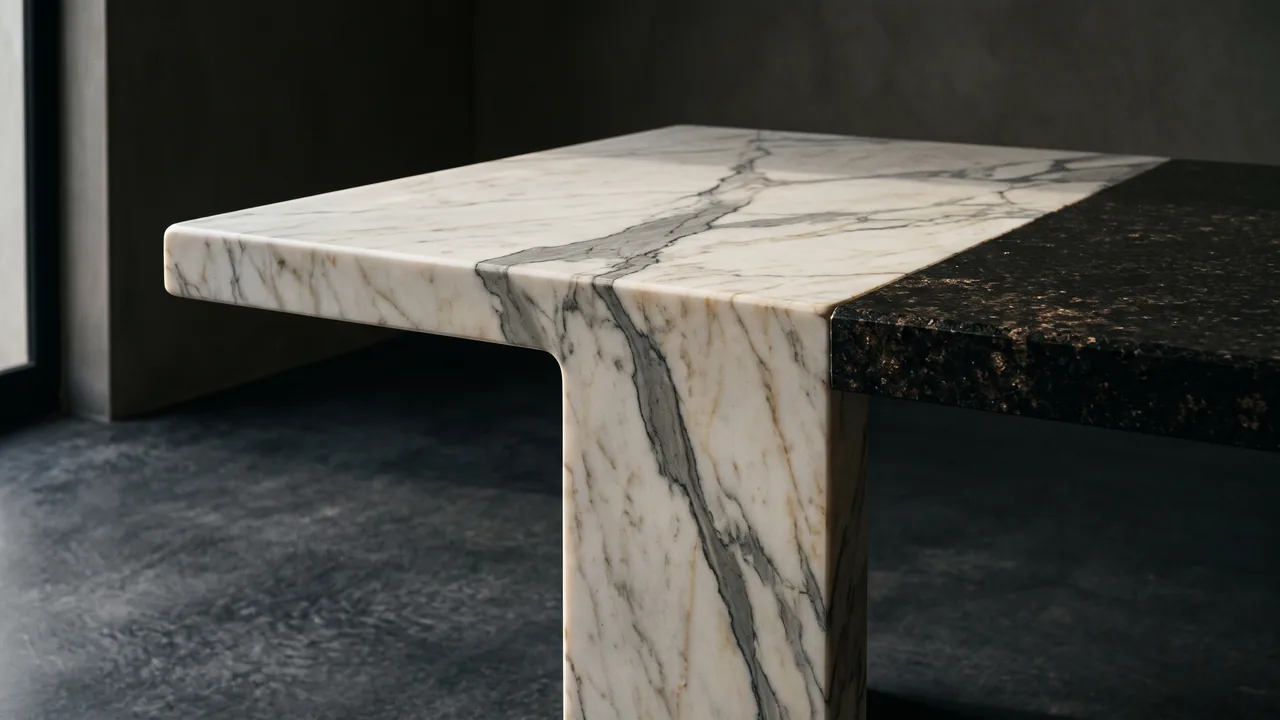
Here is the strange thing about this comparison: you almost certainly already live with granite. Walk into your kitchen and put your hand on the platform. That is granite, and it has probably survived a decade of hot kadhais, spilled tamarind and knives set down without ceremony — and in all that time you have almost certainly never once looked at it.
That is the real question hiding inside marble versus granite. Not which stone is tougher — we can settle that in a paragraph. The question is what you want a dining table to be: something that disappears into service, or something the room is arranged around.
The 30-second answer
Choose granite if the table must be indifferent. It does not etch, it does not mind heat, and a household that cooks with lemon and tamarind daily and does not want to think about coasters will never once be punished for it.
Choose marble if you want the table to be the reason people look up when they walk in. No granite on earth has the veining of an Indian Statuario or the decisive white lightning of a Bhainslana Black. The price of that is a surface that keeps a record of your life — and either you find that beautiful, or you should buy granite.
Everything below is why.
What they actually are
Marble is a metamorphic stone, limestone recrystallised under heat and pressure. It is made largely of calcite — a mineral soft enough to carve into fine detail and, crucially, chemically reactive.
Granite is igneous: it was molten, and cooled slowly underground while quartz, feldspar and mica crystallised out of it. Those interlocking crystals are what you see as the speckle, and they are why granite is hard, heat-indifferent and chemically dull. It is not that granite resists acid heroically — it simply has nothing in it for kitchen acid to react with. Two origins, two temperaments; nearly everything else follows from that.
Vein or grain: the difference nobody mentions
Most guides argue durability and stop. But you will look at this table every day for thirty years, so start with the honest aesthetic difference: marble veins, granite grains.
A vein is a line with direction. It travels across a slab, and because we carve from a single block, it can be made to run over an edge and continue down a leg as though the table were quarried whole — because it was. That continuity is the whole argument for a monolith, and it is a marble argument.
Granite's beauty is granular and even: a field of crystal rather than a drawing. A Black Galaxy from Chimakurthy in Andhra Pradesh — a gabbro, strictly, though the whole trade sells it as granite — with its bronze flecks suspended in near-black, is genuinely gorgeous. But gorgeous the way a night sky is, uniformly and everywhere at once. It does not compose. Cut a Black Galaxy table in half and both halves look the same. Cut an Indian Statuario in half and you have two different pieces of art.
So: a stone with a pattern, or a stone with a picture? That question resolves this choice for more of our clients than any durability table ever has.
The honest gap: etching
This is where we tell you the unflattering truth about the stone we love most.
Marble etches. Lemon, vinegar, wine, tamarind — the acids react with the calcite and leave a dull mark. It is not a stain, it does not wash off, and as our care guide says plainly, no amount of cleaning removes it; only professional refinishing does. Granite does not do this. Not less — not at all.
Two honest softeners. Etching is a finish phenomenon: it shows starkly on polished marble and far less on a honed surface, which is why we steer hard-working marble tables to honed. And marble is softer than a steel knife, so a board matters; granite does not care. If both trade-offs sound unwelcome, that is not a failure of taste — it is a signal, and it points at granite.
If you want marble's look with granite's indifference, there is a third answer: quartzite carries marble-like veining at near-granite hardness. Our choosing your stone guide is the shorter overview across all three.
Weight, and the question that actually matters
People ask whether granite is too heavy for the floor. It is a reasonable worry aimed at the wrong target: marble and granite weigh almost exactly the same — roughly 2.6 to 2.7 tonnes per cubic metre — so switching stone changes your table's weight hardly at all, and an ordinary Indian slab floor carries either without complaint.
The question worth asking is about the route in. A monolithic dining table is not flat-packed. Stairwell turns, lift depth and door widths decide what can reach your third-floor flat, long before the block is cut. We measure that path during a commission, and it occasionally reshapes a design — a constraint we would rather raise early than discover on delivery day.
The granite problem: making stone read as furniture
Granite carries baggage in India, and it is worth naming. Because it is the default kitchen platform in millions of homes, it can read as utilitarian — the stone of the working surface, not of the room you receive people in.
That association is about form, not geology. Granite reads as a counter when it appears as a thin polished slab on a metal frame, because that is exactly what a counter is. Carve the same stone as a monolith — a real edge with weight to it, a honed finish that absorbs light rather than bouncing it, a base that is part of the piece rather than a stand under it — and it reads as what it is: a single block of stone shaped into furniture.
The stone was never the problem. The thin slab was.
How we choose at Indic Decor
We ask three questions, in this order. How will the table actually be used — daily dinners with tamarind and lime, or a table that hosts twice a month? Does a patina read to you as history or as damage? And what is the room asking for: a quiet surface, or the thing everything else defers to?
Answer those honestly and the stone usually names itself. Both philosophies live in our dining collection — Vajra makes the marble argument in white stone, Prastha in Golden Ivory Quartzite the near-indifferent one. Our materials guide walks through every stone we carve; granite we source to commission, matched to the piece.
And if you want to see either standing in your own dining room before committing to a block, the Visualizer will show you in under a minute — easier than imagining 400 kilos of stone from a photograph.
Imagine It. Visualize It. We Build It.
Not sure which stone?
Tell us the room, the stone you are drawn to, and how the table will actually be used — and we will tell you honestly whether marble or granite serves you better, before a single block is cut.
Frequently asked questions
Is granite better than marble for a dining table?
More forgiving, not better. Granite resists the acids, heat and scratches that mark marble, so it suits a household that would rather not think about the table at all. Marble offers veining granite cannot match, and rewards a family at peace with a patina.
Does granite etch or stain like marble?
Granite does not etch — there is no calcite in it for lemon, tamarind or vinegar to react with, so a spill leaves no dull mark. It can absorb a stain if left unsealed under oil or turmeric for a long time, which a periodic sealer prevents. Reseal when water stops beading.
Which is more expensive, marble or granite?
It depends on the block, not the category — a rare marble can cost many times a common granite, and an exceptional granite can outprice an ordinary marble. On a commissioned piece, the size, block and carving matter far more to the final figure than the category itself.
Is a granite dining table too heavy for an apartment floor?
Almost never, and marble would not be lighter — the two weigh roughly the same. A normal Indian slab floor carries either comfortably. The real constraint is the route in: stairwells, lift dimensions and door widths, which we measure during the commission.
Can a granite table look like furniture rather than a kitchen counter?
Yes, and it is a question of form and finish rather than stone. Granite reads as utilitarian when it is a thin polished slab on a frame. Carved as a monolith with a substantial edge and a honed finish, the same stone reads unmistakably as furniture.