Journal · Craft
What Custom Stone Furniture Costs — And Why
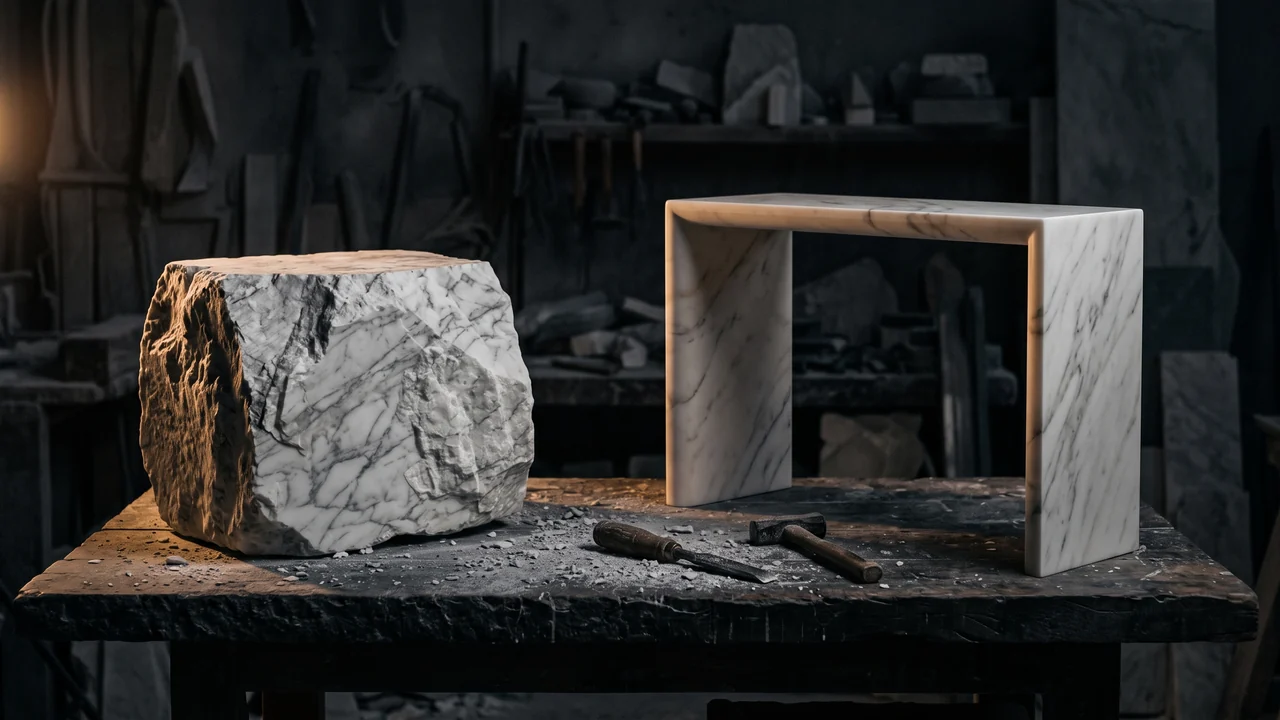
It is the first question almost everyone asks, and the fairest one: what does a piece like this cost? The honest answer is that there is no single number to give — not because we are being coy, but because there is no single piece. Every work leaves our atelier carved to order from one block of natural stone, sized to your room and shaped to your design. A price list would be a fiction. What we can do — and what this piece sets out to do — is open a quote up and show you exactly what is inside it, so the number you eventually receive feels understood rather than mysterious.
This is the anatomy of a quote: why stone is priced the way it is, the four things your money actually pays for, what moves a figure up and what genuinely doesn't, and why you will never see a discount from us. No sales pitch — just the working, left in.
Why there is no price list
A factory sofa has a price because there are ten thousand of it, all identical, and the cost of designing and tooling it is spread across every unit. A commission is the opposite of that. Yours is the only one of its kind, cut from a block that will never be quarried again in quite the same veining, at a size no other customer has asked for. There is nothing to spread the cost across, and nothing to compare it to.
So instead of a list, we price to the piece. That is not a euphemism for "as much as we can get" — it is the only truthful way to price a one-of-one object. When you request a quote, we build the figure up from its real parts and hand it to you itemised, so you can see where every rupee goes. Our pricing page lays out the same logic in brief; this article is the longer, honest version of it.
The four things a quote pays for
Strip a quote down and it always rests on the same four foundations. Nothing else is hiding in it.
The block itself. Everything starts with the stone, and stone is not one price. A common Indian marble and a rare, dramatically veined one can differ enormously per cubic foot before a single cut is made — the origin, the rarity and the sheer size of the block you need all set the floor of a quote. A large solid table needs a large sound block with no hidden flaws, and blocks like that are scarce. You can see the temperament and relative rarity of each stone on our materials page — every one Indian-quarried.
Scale and solidity. Our pieces are solid stone at full thickness, not a slab bonded to a hidden frame. That honesty is the whole point, and it is also weight — and weight is material. A heavier, larger piece uses more stone, takes more of it to waste in the carving, and asks more of every stage that follows. Doubling the visual size of a piece more than doubles the stone inside it.
Carving and finish. This is the hand, and it is the part machines cannot shortcut. A plain honed surface is one thing; a moulded edge, a fluted face, a relief or a deeply hollowed form is many times the labour. Finish matters too — the difference between a matte honed surface and a mirror polish is hours of patient work. The more the human hand is asked to do, the more of the quote is craft rather than material.
Delivery and installation. Getting a heavy stone piece into your home is a craft of its own, and it is inside your quote, not bolted on afterwards. Crating, white-glove transport, placement and installation are all itemised up front. We would rather the delivery-day number be part of the honest total than a surprise at your door.
What moves a quote up — and what doesn't
If you want a rough intuition before you ever speak to us, think in three broad bands. A compact piece — an entrance console or a side table — sits at the accessible end. A generous dining table in solid stone sits in the middle. A monumental piece — a carved portal, a fountain, a large sculpture — sits at the top, because it combines a big rare block, heavy solid mass and the most carving. Most homes are choosing somewhere in the first two bands.
Three things reliably move a figure upward: a rarer stone, a larger and heavier form, and denser hand-carving. Two things people expect to matter but don't, much: a tight deadline will not buy you a lower price, and a "simpler" design does not always mean a cheaper one if it still needs a large flawless block. The lever most within your control is the stone — choosing a beautiful but less scarce Indian marble can change a quote more than shaving an inch off a dimension ever will. Our guide to choosing a stone is the best place to weigh that trade-off.
Why we never discount
We should be direct about this, because you will notice its absence: we do not discount, ever. No festival sales, no "closing this week" pressure, no figure you can haggle down if you push. This is a deliberate position, not an oversight.
A discount is only ever one of two things. Either the first price was inflated so it could be cut — in which case the "offer" is theatre and the original number was dishonest. Or the price is real and the discount is being paid for somewhere you can't see: a thinner stone, a rushed finish, a corner quietly turned. We are not willing to do either to a piece meant to outlast the people who commission it. Our quote is the honest price the first time you see it, built from the four parts above and nothing else. You pay a fair figure once, and what arrives is exactly what you agreed to.
How a commission is paid
The structure is simple and there are no hidden stages. Once you approve the design, a deposit confirms the piece and secures your place in the atelier schedule — nothing is cut until you confirm. The balance is settled only after the work is finished and inspected, before it is dispatched. Because the quote is itemised and agreed at the start, nothing changes underneath you along the way.
Between deposit and delivery, the build itself is typically 8 to 18 weeks, depending on the stone, the size and the finish — stone is cut slowly and hand-finished, and a rushed cut cannot be undone. You are kept in the picture the whole time. The full journey, stage by stage, is laid out in how a commission actually works and on our process page. If you are planning toward a festival or a fixed date, our note on why the monsoon is the best time to commission explains how to make the calendar work in your favour rather than against it.
Seeing the value before you commit
Numbers on a page are hard to feel; a piece in your own room is not. Because a carved form is genuinely difficult to picture from a slab photograph, the Visualizer will place a piece in a space like yours in under a minute — so you can judge the scale and the stone against your walls before you ask for a quote, let alone commit to one. It is the fastest way to turn "I wonder what that would cost" into a specific, priceable idea.
When you are ready, tell us the piece, the stone and the space, and we will prepare a clear, itemised quote with no obligation — for a custom commission of your own or for a piece you have seen here. Every one of them begins the same way: Imagine It. Visualize It. We Build It.
Imagine It. Visualize It. We Build It.
Curious what your piece would cost?
Share your idea, your dimensions or a reference, and we will prepare a clear, itemised quote — built honestly from the block, the scale, the carving and the delivery, with no obligation and no pressure.
Frequently asked questions
How much does custom stone furniture cost in India?
There is no fixed price, because there is no fixed piece. Every work is carved to order from a single block of natural stone, so each commission is quoted individually to your design, your stone and your space. A compact side table sits at one end of the range and a monumental portal or a rare-stone dining table at the other, with most furniture landing in between. Rather than a misleading headline number, we prepare a clear, itemised quote for the exact piece you have in mind — with no obligation.
Why is natural stone furniture more expensive than wood or engineered stone?
Three honest reasons. First, the material: a solid piece is carved from one heavy block of natural stone, and a good block of a rare stone is itself expensive and finite. Second, waste: shaping a form out of solid stone removes a great deal of material that cannot be reused, so you are paying for more stone than you finally see. Third, the hand: carving and hand-finishing are slow, skilled work measured in weeks, not minutes. Engineered surfaces and veneers are cheaper because they use a thin layer over a substrate and are machine-made in volume. A single-block natural piece is a different object made a different way.
Do you offer discounts or sales?
No. We do not run discounts, festival sales or negotiated markdowns, and we never will. A quote is built up honestly from the block, the scale, the carving and the delivery — it is not inflated so it can later be cut. Discounting would mean either the first price was dishonest or the work is being quietly compromised to protect a margin, and neither is a way to treat a piece meant to last generations. You pay a fair price once, itemised and agreed up front.
Is delivery and installation included in the quote, or extra?
Included. Crating, white-glove delivery, placement and installation are itemised inside your quote, not added afterwards. Stone is heavy and unforgiving to move, so getting it into your home safely and set exactly where it belongs is part of the commission, not an afterthought. Every quote is itemised and agreed up front — no surprises on delivery day.
How are payments structured for a commission?
In two stages. After you approve the design, a deposit confirms the piece and secures your place in the atelier schedule — nothing is cut until you confirm. The balance is settled once the work is finished and inspected, before it is dispatched. Because the quote is itemised and agreed at the start, there are no mid-project surprises.
How long does a stone commission take to make?
The build is typically 8 to 18 weeks, depending on the stone, the size and the finish. Carving is slow and patient work — a rushed cut in stone cannot be undone, so nothing is rushed. If you are planning toward a festival, a housewarming or a fixed date, it is worth starting the conversation early so the timeline works in your favour.