Journal · Craft
Bookmatched Marble: One Block, Mirrored
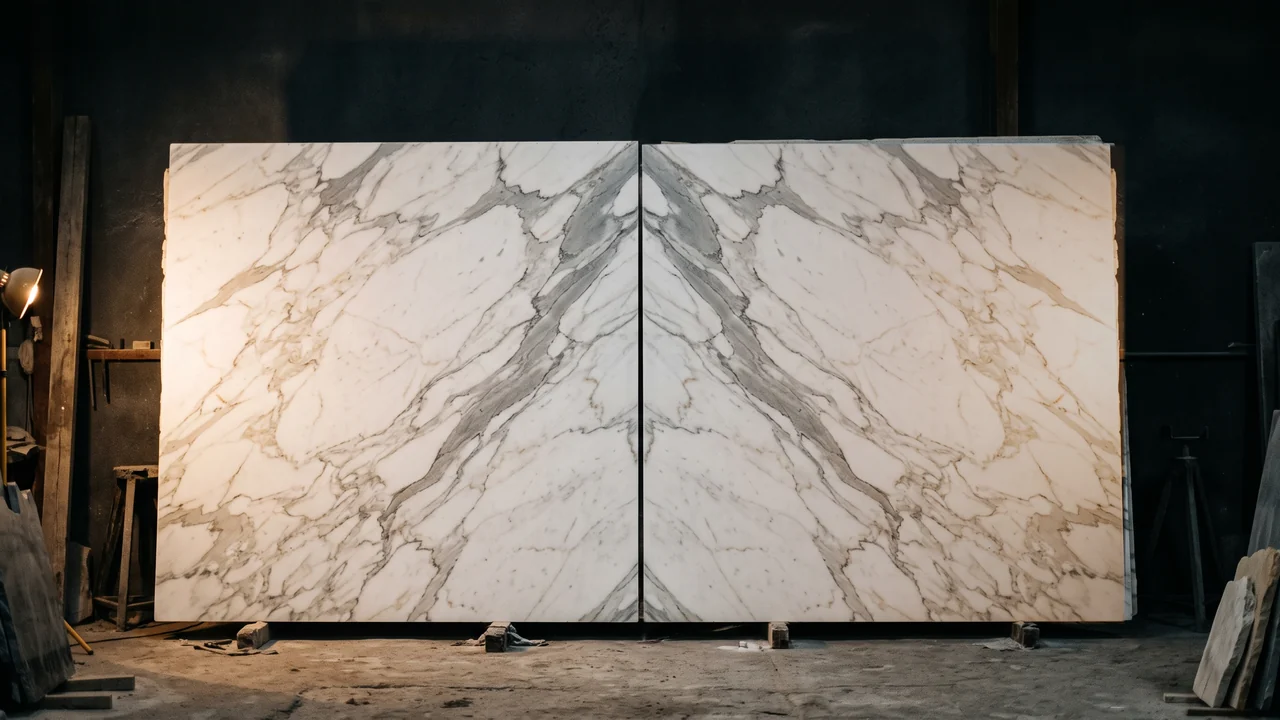
There is a moment in a stone yard that never quite loses its effect. Two slabs are stood up side by side, and the veining that wanders across the first one turns around at the seam and walks back across the second — the same rivers, the same shorelines, reversed. Then somebody asks how it was done, expecting an answer about printing, or clever selection, or luck.
It is none of those. The two faces were touching inside the block — a saw-blade apart — until the blade passed between them. Opened out like the two pages of a book, they show the same geology twice, once from each side. That is bookmatching: the material does the drawing, and the craft is entirely in not spoiling it.
How a block becomes a mirror
A block of marble comes out of the quarry as a rough rectangle weighing several tonnes. At the cutting shed it is sawn into slabs the way a loaf is sliced — parallel blades passing through it in one long, slow, water-cooled pass. Because veining runs through stone in three dimensions rather than sitting on the surface, each successive slice is a slightly deeper reading of the same pattern.
Stand slabs one and two next to each other exactly as they came out and you get a repeat: the pattern shifted a little, like the next frame of a film. Flip the second one over instead and you get a mirror — you are now looking at the two opposing faces of a single cut, symmetrical around the line the blade travelled. It costs nothing except discipline: the slabs must stay in order, stay together, and be turned the right way.
The rest is judgement. Where you place the mirror line decides what the surface says — slide the pair up or down against each other and the same two slabs will read as a butterfly, a flame, a pair of wings, or nothing much at all. This is why a bookmatch is dry-laid: set out flat on the workshop floor, looked at, moved, argued about, and only then cut to size.
Bookmatch, quad match and the others
Bookmatching is one of a family of ways to sequence slabs from one block, and the words get used loosely in the trade, so it is worth being precise. A bookmatch is two slabs mirrored across one line — the classic butterfly. A quad match (or four-way match) mirrors four consecutive slabs both horizontally and vertically into a figure symmetrical around a centre point; it is the most theatrical option, and the one that most often turns a wall into a Rorschach test. A slip match flips nothing — consecutive slabs simply run side by side in order, so the pattern steps along rather than reflecting; quieter, and useful for long runs where a mirror would look forced. An end match continues the pattern vertically rather than horizontally, for tall surfaces.
The same principle can turn a corner rather than run flat. On Prastha, our Golden Ivory quartzite dining table, the honey veining runs the length of the top and continues over the mitred waterfall edge to the floor, matched across the mitre so the eye follows it around the corner unbroken — a joint, carefully made, carrying one continuous pattern from one plane to another.
Which stones are worth mirroring
Bookmatching only pays when there is something to mirror. It amplifies whatever pattern the stone already has: bold, directional veining gives drama, and even, all-over character gives almost nothing.
From our own collection, Indian Statuario — the luminous near-white marble from Banswara, crossed by bold grey and faint gold veining — is the classic candidate, and the one most people picture when they say "bookmatched marble". Bhainslana Black, with its fine, decisive white veining on a deep black ground, mirrors into something graphic rather than soft. Udaipur Green, laced with a network of fine white veins, gives a denser, tapestry-like figure that suits a smaller surface better than a large one.
At the other end, Jaisalmer Gold — a warm golden limestone flecked with fossil and shell — is beautiful precisely because its character is even across the whole face; mirroring it changes very little, as with any stone chosen for a fine, regular texture. There is no fault in those stones; they are doing a different job, and paying extra to match them buys an effect you will not see. If you are still weighing materials, our guide to choosing your stone is the better place to start.
The honest limits
Four things are worth knowing before you fall for the idea.
A bookmatch is a joint, not a monolith. This matters to us because so much of our work is carved from a single block with no joint anywhere in it. A bookmatched surface is the opposite proposition: two pieces of stone deliberately meeting at a mirror line. Nobody should sell you a bookmatched wall as "seamless". What you get is continuity of pattern across a joint made as fine and as symmetrical as it can be — a genuine achievement, just not the same one.
The match is close, never atomic. The saw removes a few millimetres of stone as it passes, so the two faces were never quite touching — they are one blade-width apart. On a boldly veined marble the shift is invisible; on a stone with very fine detail you can sometimes see the veins step slightly at the line.
You are buying a set, not a slab. The slabs must be consecutive cuts from the same block and stay together from yard to wall. That means reserving part of a block rather than picking loose slabs, more waste in the cutting, and careful handling — because if one panel is damaged, there is no exactly matching replacement anywhere in the world. That is the real reason a bookmatched surface costs more, and it appears as its own line in an itemised quote rather than as a mysterious premium; our note on what stone work costs, and why explains how the rest of the figure is built.
The block decides, not you. Until it is opened, nobody knows exactly what the mirror will look like — including us. The mitigation is non-negotiable: dry-lay first, photograph it, choose the mirror line together, and only then cut. The pattern also cannot be unseen — quad-matched walls in particular have a way of resolving into a face or a figure for whoever lives with them, so it is worth standing in front of the dry-lay and asking honestly whether you will still like it in five years.
Where to use it — and where not to
A mirrored surface is a focal point, and a room can only carry one. It earns its keep where you look deliberately: a feature wall behind a bed or a sofa, a fireplace face, the front of an island or bar, a shower wall, or a framed panel treated frankly as art. Our stone paintings are commissioned exactly this way — bookmatched slab faces, framed veining, relief panels — and a mirrored pair can equally be specified as one of our stone surfaces. The framed version is often the wiser choice in an Indian apartment, where a full feature wall can overwhelm the room it is meant to lift.
It works less well in corridors and spaces seen only in passing, on surfaces broken up by sockets and shelf brackets, and in any room that already carries a second strong pattern. Finish matters too: a polish throws light across the veining and makes the mirror shout, while a honed surface lets it murmur — a trade-off set out in honed or polished.
Commissioning a bookmatched surface
In practice the sequence is: choose the stone, reserve the block, open it, dry-lay the pair or the quad, agree the mirror line and the finish, then cut and install. It is one of the few things in stone where the decisive judgement happens on the workshop floor rather than on a drawing — which is why we photograph the dry-lay and send it to you before anything is cut. The process is the one every commission follows, and the cutting and finishing that follow the dry-lay are the longest and most patient part of it.
To picture a mirrored surface in a room you already live in, the Visualizer will place stone into a photograph of your own space in about a minute — far more useful than a swatch for judging whether a wall of veining will lift your room or swallow it. When you know what you want, tell us the wall, the stone and the space, and we will prepare a clear, itemised quote for a commission of your own. Every one begins the same way: Imagine It. Visualize It. We Build It.
Imagine It. Visualize It. We Build It.
Thinking of a mirrored wall?
Send us the wall, the room and the stone you have in mind. We will talk you through what that block is likely to give you, dry-lay it before anything is cut, and prepare a clear, itemised quote — with no obligation.
Frequently asked questions
What does bookmatched marble mean?
Bookmatching means two slabs cut one after the other from the same block are opened out like the two pages of a book, so the veining on one is the mirror image of the veining on the other. The two faces were touching inside the block, a saw-blade apart, until the blade passed between them — which is why the pattern lines up across the seam. It is not a printed or repeated pattern — it is the same geology, seen twice, once from each side.
Is a bookmatched surface made from a single block with no joints?
It comes from a single block, but it is not jointless. A bookmatch is by definition two pieces of stone meeting at a mirror line, and that line is a real joint. Anyone who tells you a bookmatched wall is seamless is describing something else. What the technique gives you is continuity of pattern across that joint, so the eye reads one image rather than two panels — but the joint is there, and a good installation makes it as fine and as symmetrical as possible rather than pretending it does not exist.
Which stones bookmatch well?
Stones with bold, directional veining reward bookmatching most: a white marble crossed by strong grey veins, or a dark marble with decisive white lines, produce a dramatic mirrored figure. Stones whose beauty is even and all-over — a fossil-flecked limestone, a stone with a fine linear texture — gain very little, because there is no strong pattern to mirror. Before committing, it is worth looking at the actual slabs rather than a swatch: the whole effect depends on what that particular block is doing.
Where is bookmatching used in a home?
Most often on a single deliberate focal surface: a feature wall behind a bed or a sofa, a fireplace face, the front of a bar or island, a shower wall, or a stone artwork framed like a painting. It works best when it has room to be looked at and nothing competing with it. One bookmatched surface in a room reads as a work of art; two in sight of each other tend to fight, and the drama of both is lost.
Is bookmatched stone more expensive?
Usually, yes — not because the technique itself is costly, but because of what it requires. The slabs must be consecutive cuts from one block and kept together as a set, so you are effectively reserving part of a block rather than buying loose slabs, and there is more cutting waste in aligning the mirror. The stone must also be handled and sequenced carefully, since a damaged slab cannot be replaced with a matching one later. Your quote is itemised, so this shows up plainly rather than being buried.