Journal · Materials
Quartz vs Quartzite: The One-Letter Difference
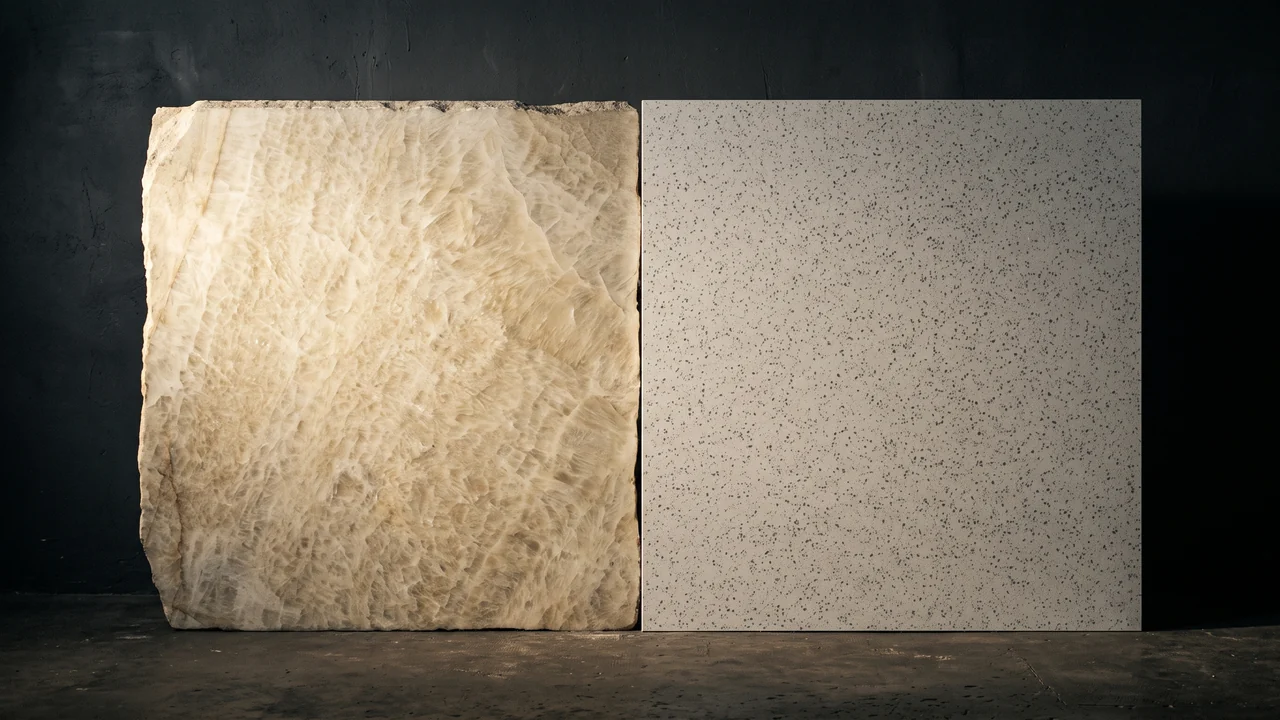
Two materials, one letter apart, sold from the same showrooms, often by the same salesperson, frequently in the same sentence. Quartz and quartzite are not variations of each other. One is a natural stone quarried in blocks; the other is a manufactured slab of crushed mineral bound in resin. They behave differently under heat, under a chisel, and over thirty years — and the confusion costs Indian buyers real money, usually at the moment they ask for something to be carved.
This is the honest version, including where the manufactured material genuinely wins, and where the trade quietly mislabels the natural one.
What each one actually is
Quartzite is a natural stone. It begins as sandstone; heat and pressure deep in the earth fuse the sand grains until the quartz recrystallises into a single interlocked mass. What comes out of the quarry is one of the hardest decorative stones available — around 7 on the Mohs scale, harder than a steel blade, harder than most granite. It is cut from blocks, and every slab is unlike every other slab.
Quartz — engineered quartz, to give it its full name — is a factory product. Roughly nine parts crushed natural quartz are mixed with about one part polymer resin and pigment, then vibro-compacted and cured into a flat slab. The quartz in it is real; the slab is not stone. It is a composite, and the resin is not a technicality — it decides almost everything about how the material lives.
So the shorthand: quartzite is geology, quartz is manufacturing. Every difference below flows from that one fact.
Heat, sunlight and the resin problem
Put a pan straight off the flame onto engineered quartz and you risk a mark you cannot undo. The mineral does not care about the heat; the resin binding it does, and it scorches, yellows or crazes well below the temperature an Indian kitchen reaches routinely. Manufacturers say so themselves, in the trivet advice printed on every warranty card.
Quartzite has no binder to damage: set down a hot vessel and the stone itself is unharmed. A trivet is still worth using — it protects the sealer at that spot, and no natural material loves a sudden temperature extreme — but the material is not the thing at risk. The same holds for sunlight: resin yellows under prolonged UV, which is why engineered quartz is not recommended outdoors, while natural quartzite is entirely at home on a terrace, a courtyard ledge or a garden table through a Delhi summer and the monsoon that follows.
If a piece will live near flame, near a window that gets hard afternoon light, or outside at all, that is usually the end of the argument.
The carving question
This is where the difference stops being academic for us. Engineered quartz arrives as a flat slab of fixed thickness. You can cut it, edge it and join it — that is the whole design vocabulary. There is no block, so there is nothing to carve. A basin, a fluted plinth, a hollowed tub, a sculpted leg: none of it exists in engineered quartz, and anything that resembles it is several flat pieces glued into the shape of a solid one.
Quartzite comes in blocks, so a piece can be taken out of one. Prastha in Golden Ivory Quartzite is a dining table whose top and mass read as one continuous stone rather than a slab set on a frame; Meru is a monolith basin in Pearl White Quartzite, bowl and body hollowed from a single block with no seam anywhere in the water's path. That continuity is the whole reason we work in natural stone, and it is the same argument we make across the dining collection and the bath range.
We are not neutral here, and it is fairer to say it plainly than to pretend: Indic Decor does not work in engineered quartz. Not because it is a bad material, but because it cannot do the one thing we exist to do.
Sealing, staining and honest maintenance
Now the part that favours the factory. Engineered quartz is effectively non-porous. It never needs sealing, it resists wine and turmeric with real indifference, and it arrives dead consistent — the slab in the showroom is the slab that reaches your kitchen. For a long kitchen counter run that will be jointed anyway, around a sink, in a household that would rather not think about a surface ever again, that is a genuinely good answer.
Quartzite asks a little of you and gives more back. It is dense and among the most stain-resistant natural stones, but it is still stone: a penetrating sealer, reapplied when water stops beading on the surface — realistically once a year in hard use — keeps oil and pigment out of its pores. That is the entire discipline, and it is the same one described in our care guide. Quartzite's hardness also means it resists the acid etching that troubles polished marble, which is why it suits households that cook seriously; where marble is the more demanding beauty, quartzite is the quieter workhorse, a comparison we drew at length in marble vs quartzite.
One caveat worth stating: quartzite is hard enough to be difficult to fabricate. Cutting and finishing it wears through tooling faster than marble does, and that cost is real and shows up in the price. It is not a stone to buy from someone who has not worked it before.
The mislabelling problem in India
Here is the trap. A significant share of slabs sold as "quartzite" in Indian yards are not quartzite at all — they are dolomitic marble, which looks strikingly similar, is far softer, and will etch and scratch in service exactly as marble does. The buyer specified a hard stone, paid for a hard stone, and installed a soft one.
Two field checks. First, scratch: real quartzite will scratch glass, and a steel blade will not scratch it — on soft look-alikes the result reverses. Second, acid: a drop of lemon juice on an offcut will dull a dolomitic marble within minutes and do nothing at all to quartzite. Ask for an offcut and test it; any yard confident in what it is selling will hand you one. And ask the same question we ask on every commission — which quarry, which block — because a supplier who can answer that is a supplier who knows what the stone is. Choosing well is less about the label than about provenance, which is the argument running through choosing your stone.
So which should you buy?
Buy engineered quartz for long, jointed, hard-working kitchen counters where uniformity is the point, nothing sculptural is wanted, and the surface will never see flame or full sun. It is honest value doing an honest job.
Buy quartzite when the piece is the point — when it will be carved, when it stands alone, when it goes outdoors, when a hot vessel will land on it and the stone will not care, and when you want a stone nobody else has because no two blocks are alike. Give it a honed finish if it will be handled daily; leave it polished if it is there to catch light.
If you are deciding between the two for a specific room, the fastest way to settle it is to see the piece in your own space rather than in a yard: the Visualizer will place a quartzite piece into a photograph of your room in under a minute. After that the conversation is about the block, not the category. Imagine It. Visualize It. We Build It.
Imagine It. Visualize It. We Build It.
Not sure which stone your piece wants?
Tell us the room, the use and the light it gets, and we will tell you honestly which stone belongs there — quartzite, marble or granite — and which block we would cut it from.
Frequently asked questions
Is quartz the same as quartzite?
No. Quartzite is a natural stone quarried in blocks, formed when sandstone recrystallises under heat and pressure. Engineered quartz is a manufactured slab of roughly 90% crushed quartz bound with polymer resin. They share a mineral and almost nothing else — the resin in engineered quartz makes it heat-sensitive, UV-sensitive and impossible to carve, while natural quartzite is none of those things.
Which is harder, quartz or quartzite?
Natural quartzite is harder in practice, sitting around 7 on the Mohs scale — it will scratch glass and resist a steel blade. Engineered quartz is scratch-resistant but is limited by its resin binder, which is much softer than the mineral it holds together. In daily use the practical difference shows up as heat damage rather than scratching.
Does quartzite need sealing in an Indian home?
Yes, though less often than marble. A penetrating sealer once a year in hard use is enough for most homes — test by dripping water on the surface and resealing when it stops beading. Sealing does not make stone waterproof; it buys you time to wipe a spill before it soaks in.
How do I know if a slab sold as quartzite is really quartzite?
Ask for an offcut and run two tests. Real quartzite will scratch glass and will not be scratched by a steel blade. A drop of lemon juice will leave it untouched, while a dolomitic marble sold as quartzite will dull within minutes. Also ask which quarry and which block the slab came from — a supplier who cannot answer that may not know what they are selling.
Can engineered quartz be carved into a basin or a table base?
No. It is produced only as flat slabs of fixed thickness, so any shape beyond cutting and edging is several pieces joined to imitate a solid form. Carved basins, hollowed tubs and sculpted bases require a block, which means natural stone.