Journal · Design
Stone in the Indian Bathroom: The Case Against the Joint
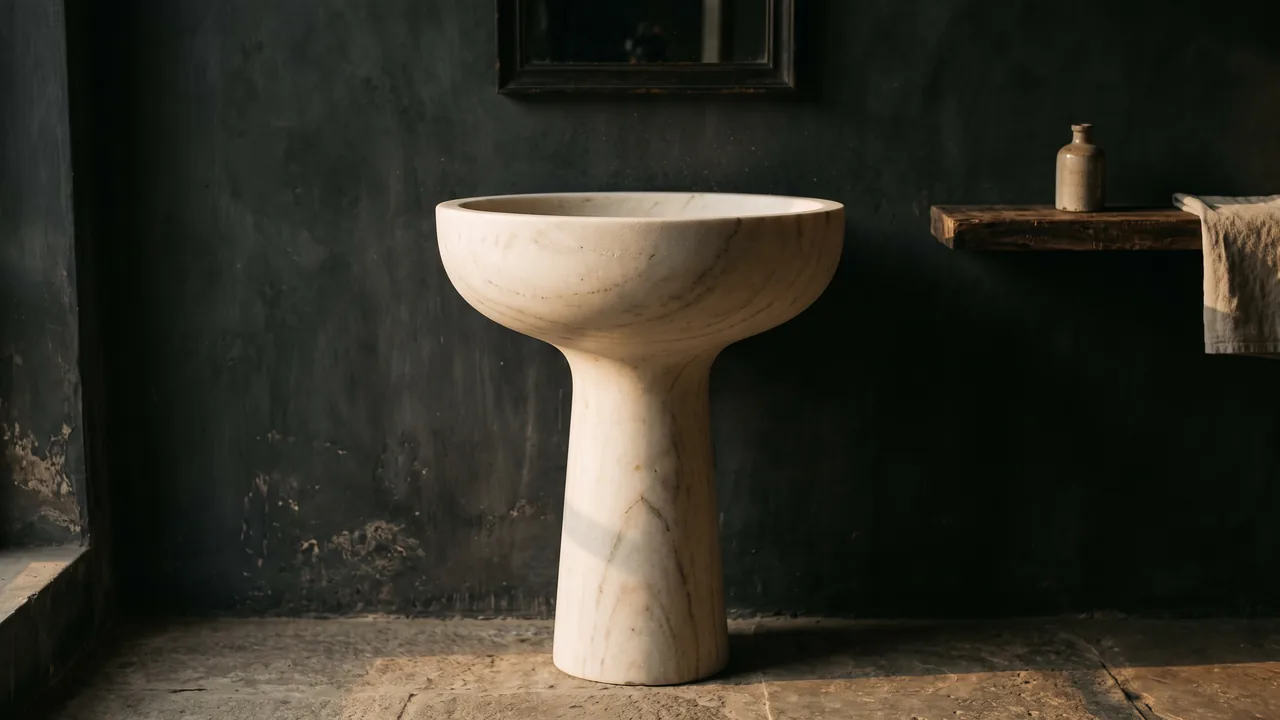
Every room in a house ages gently except one. The bathroom ages at its edges. Look closely at almost any Indian bathroom five years on and the story is written in its seams: the grout gone grey between tiles, the silicone around the washbasin peeling and specked black, the join where the counter meets the wall quietly weeping. The tiles are fine. The stone is fine. It is the joints that failed.
That single observation is the whole argument for carving a basin or a tub from one block of stone. Not romance, not weight, not even beauty — though all of that follows. The case for the monolith in a bathroom is that a bathroom dies at its joints, and a monolith does not have any.
Why the joint is where bathrooms fail
A bathroom is the harshest room in an Indian home. It is wet several times a day, hot from the geyser, cold in winter, doused in soaps and acids and cleaning agents, and — in most of the country — supplied with hard water that leaves a mineral film on everything it touches. Materials do not fail evenly under that assault. They fail where two materials meet.
A fitted washbasin is a bowl glued and sealed into a counter. A tiled bath surround is dozens of small pieces held apart by grout. Each seam is a hairline the width of a rupee coin's edge, and each one is porous, flexible, and slowly moving as the building breathes and the temperature swings. Water finds it. Then soap film settles in it, then mould colonises the film, and within a few years the seam is black, the silicone has shrunk away from the stone, and moisture is travelling somewhere it was never meant to go. You cannot clean your way out of it; the failure is structural, not cosmetic.
Remove the seam and you remove the failure. That is the entire premise.
What "monolithic" actually means
Monolithic is not a marketing word for us; it is literal. A monolith basin is a single block of stone with the bowl, the pedestal and the surround carved out of it as one continuous form — no bowl set into a top, no rim glued down, no joint anywhere in the water's path. A stone bathtub like Sarovar is hollowed from one block of Indian Statuario, so the inside surface a person actually touches is unbroken from lip to floor.
The difference is invisible on the first day and decisive over a decade. Water inside a monolith has nowhere to go but back out the way it came. There is no rim to lift, no adhesive line to fatigue, no low seam where scum gathers. The piece cleans in one wipe because there is one surface. This is the same argument we make for a dining table carved from a single block — continuity is not a style, it is how the object survives use.
Hard water: the honest Indian truth
Here is where we tell you the unflattering part, because a bathroom journal that skips hard water is not being honest. Much of India runs hard water — dissolved calcium and magnesium that dry as a pale, chalky film. On stone, as on your glass shower screen and your steel tap, that film shows as spots and rings if water is left to evaporate on the surface.
Two things worth separating. A spot is mineral deposit sitting on top of the stone; it wipes off, and a mild descaler clears any stubborn build-up. A stain is colour that has soaked into the stone — turmeric, oil, mehndi, a coloured face wash left in a puddle — and it is prevented, not cleaned, by sealing. Confusing the two makes people fear marble in bathrooms unnecessarily. Sealed stone plus the two-second habit of wiping the basin after use makes hard water a non-event, exactly as our care guide describes for the rest of the home.
And a genuine trade-off, honestly stated: on polished marble, prolonged contact with acidic bathroom products can etch — dull the shine — just as it does on a dining table. This is why we steer hard-working bathroom pieces toward a honed finish, which wears its life far more gracefully, and toward denser stones where the household would rather not think about it at all.
Basin, tub, vanity: three decisions
A stone bathroom is really three separate choices, and they need not all be the same stone.
The basin is the one you touch daily, so it carries the most decision. A vessel basin such as Anjali in Indian Statuario sits on the counter like a carved bowl and reads as jewellery for the room; a monolith basin like Shukti in cream marble is architecture — plumbing hidden, seam absent, a single sculpted mass. The tub is a monumental commitment and belongs to homes with the floor and the room for it; get the weight planning right and it is the most sculptural object you will own. The vanity — Aadhar in Bhainslana Black is a good example — is where dense, dark, forgiving stone earns its keep against toothpaste, splashes and daily chemistry.
Mix accordingly. A demanding household might take a quartzite or granite vanity and reserve a marble vessel basin for the powder room that guests admire and nobody scrubs. The full bath collection is built to be composed this way rather than bought as a matching set.
Sealing and care, without the myths
Sealing is widely misunderstood, so plainly: a penetrating sealer does not make stone waterproof and does not form a coating you can see. It fills the stone's microscopic pores so a spill sits on the surface for minutes instead of soaking in seconds, buying you time to wipe. In a busy bathroom, marble wants resealing perhaps once or twice a year — test it by dripping water and watching whether it beads or darkens; when it stops beading, reseal. Denser stones ask for it far less.
Everything else is ordinary: pH-neutral cleaner rather than acidic or bleach-based ones, a wipe-down after use to defeat hard water before it dries, and no abrasive scouring pads on a polished surface. That is the whole discipline. Stone asks less of you than the grout it replaces.
How we approach a bathroom commission
We start with three honest questions: how hard is your water, how heavily will the room be used, and what can physically reach the bathroom — because a monolith tub is not going up a tight stairwell, and we would rather establish that before a block is cut than on installation day. From there the stone chooses itself: forgiving and dense where life is busy, marble where beauty leads and the household will wipe and seal.
And because a carved stone basin is hard to picture from a slab photograph, the Visualizer will place a piece in a bathroom like yours in under a minute — far easier than imagining a single block of stone hollowed into a bowl. Every piece here begins the same way ours always have: Imagine It. Visualize It. We Build It.
Imagine It. Visualize It. We Build It.
Planning a stone bathroom?
Tell us your water, your room and how the space is used, and we will tell you honestly which stone belongs where — basin, tub and vanity — before a single block is cut.
Frequently asked questions
Does a marble basin stain from hard water in India?
It can spot, not stain, and the two are different. Hard-water minerals dry as pale rings on any surface, including glass and steel; on stone a quick wipe after use prevents them, and a mild descaler removes any that build up. A true stain — from oil, mehndi or a coloured product left to soak into unsealed stone — is prevented by sealing. Sealed stone and a two-second wipe make hard water a non-issue.
Why choose a monolithic stone basin over a fitted one?
Because a bathroom fails at its joints. A basin carved from a single block has no grout line, no silicone seam and no glued rim for water to creep behind, so there is nothing to blacken, shrink or leak over the years. A fitted or jointed assembly looks identical on day one and diverges from a monolith with every passing monsoon.
Do stone basins and bathtubs need sealing?
Marble and other calcite stones benefit from a penetrating sealer, reapplied when water stops beading — roughly once or twice a year in a busy bathroom. Denser stones like quartzite and many granites need it less often. Sealing does not make stone waterproof; it buys you time to wipe a spill before it soaks in, which in daily use is all you need.
Is a stone bathtub too heavy for an apartment bathroom?
A filled stone tub is heavy, and that is a real planning question, not a dealbreaker. The load is spread across the floor and sits above a structural wet area, but the tub's empty weight and the route in — lift, stairwell, door widths — decide feasibility long before the block is cut. We measure and advise honestly during the commission; where a monolith cannot reach a floor, we say so.
What stone is best for an Indian bathroom?
There is no single best; there is a best for how you live. Quartzite and dense granites are the most forgiving around hard water and daily chemicals. Marble is the most beautiful and slightly more demanding, rewarding a household that will wipe and seal. Sandstone suits warmer, textured schemes. The right stone follows your habits, not a ranking.