Journal · Materials
India's Dark Stones: Black Marble to Black Granite
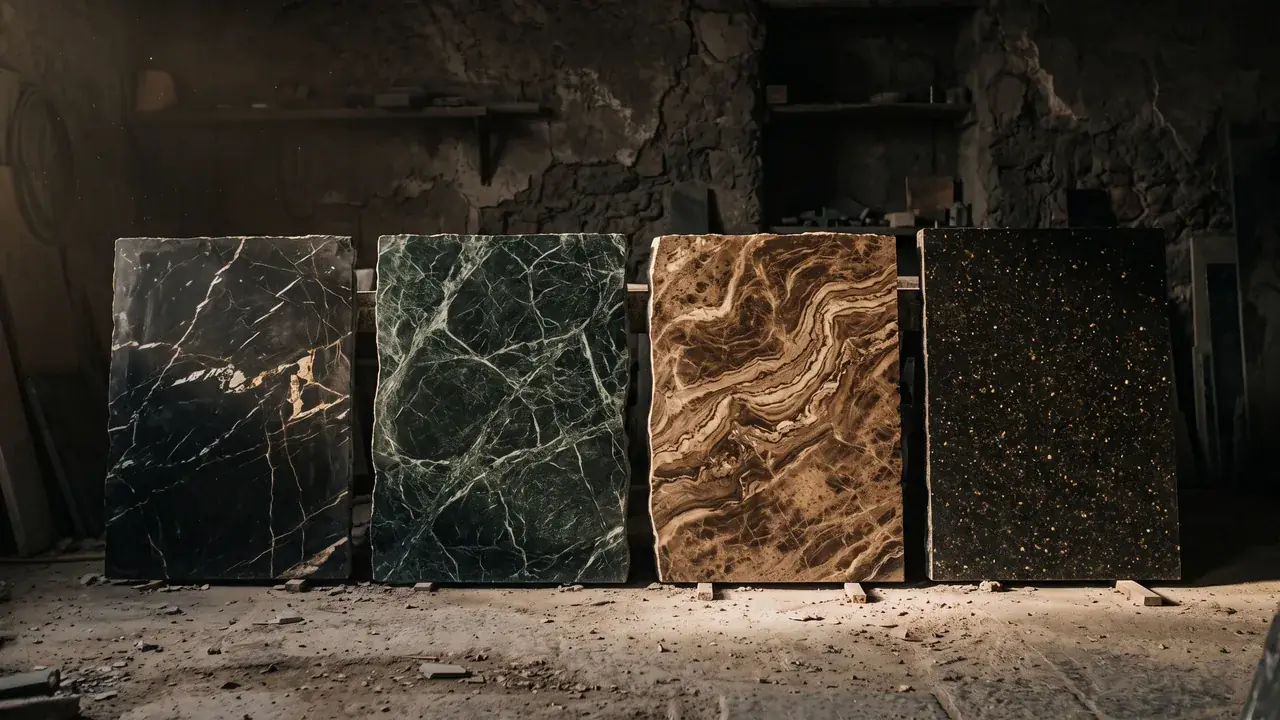
In most stone yards the pale slabs are stood at the front, because that is what people come in asking for. The dark ones are usually further back, leaning in a row where the light is poor — which is exactly the wrong place to judge them. Wet one with a mug of water and the row changes completely: black turns out to have white rivers running through it, brown turns out to be full of tide-lines, and what looked like a single dark family separates into stones with almost nothing in common.
They get lumped together as "black stone" or "dark marble" in conversation, and the vocabulary matters more here than it does at the white end of the yard — two slabs that look identical under a shed roof can belong to entirely different rocks and want entirely different lives. This is a field guide: what each of India's dark stones actually is, how to recognise it, and where it belongs in a house.
What dark stone does to a room
A pale stone reflects a room back at itself; a dark one absorbs it. That single difference drives everything else. Dark stone reads heavier than it is, so a piece in black marble looks more massive than the same piece in white at identical dimensions — useful when you want weight, punishing in a small room already short of light.
It also changes what you see. Against white marble, a stain is the enemy and dust is invisible. Against a dark ground the reverse is true: spills largely disappear, while dust, fingerprints, dried water droplets and fine scratches all show up pale and obvious. Nobody warns buyers about this, and it is the most common surprise in the first month of living with a black surface.
Finally, dark stone rewards being lit rather than flooded. A single lamp raking across a black slab picks out its veining; overhead daylight tends to flatten it into a shadow. It is why dark pieces so often work best in the rooms people assume are too dark for them — an entrance hall, a powder room, a dining room used at night.
The dark marbles
Marble is limestone that has been recrystallised under heat and pressure, and India quarries it in a range that goes well past white. These are the ones we cut; their swatches are on our stones page.
Bhainslana Black
A deep black marble from Bhainslana in Rajasthan, crossed by fine, decisive white veining — thin, straight-ish lines rather than the soft clouds of a white marble. It is the most architectural of the dark stones: graphic at a distance, almost drawn rather than grown. It takes a honed finish beautifully, which is how we most often use it — on Pravesh, a single black slab on a concealed pivot with a full-height brass pull, and on Aadhar, a vanity where twelve centimetres of the stone carries the basin carved into it, one stone, no seams. It is also the stone behind Ekashila, our monolith dining table, cut complete from a single block.
Udaipur Green
A deep green marble laced with a network of fine white veins — denser and busier than Bhainslana's, closer to a tapestry than a drawing. In low light it reads almost black and only resolves into green when something warm is switched on near it, which is why it is such a good stone for the hours after sunset. It suits smaller, closely-viewed surfaces better than vast ones: a basin like Haritha, a console, or a set of turned planter cylinders. On a large table top the pattern can start to fight itself.
Bidasar Brown and Bidasar Green
The most unusual stones in the Indian dark palette, and the hardest to photograph. Bidasar reads as swirled bands of brown or green that look less like veining than like weather seen from above, or the surface of a slow river. People either fall for it instantly or find it too busy; there is very little middle ground. We use the brown for grounded, low pieces such as Bhumi, and the green where its river-lines can be enjoyed close up, as in the Kanana basin.
Udaipur Red and Indian Viola
Not black, but they belong in this guide because they behave like dark stones rather than pale ones. Udaipur Red is a deep, saturated red with veining that runs through it like a held note — dramatic on an oval dining top, overwhelming across a whole floor. Indian Viola carries violet-grey veining over a paler ground, making it the gentlest of this family and the one that sits most easily beside white marble; Vithika, a console for an entrance hall, is cut from it.
The dark granites
Granite is an igneous rock — crystallised from molten material rather than recrystallised from limestone — and that single fact explains its behaviour. It is harder, far more resistant to acids and stains, and patterned by an even scatter of crystals rather than by veins. India is one of the world's major sources of dark granite, and the names travel further than the stones' origins do.
Black Galaxy is the famous one: a near-black ground scattered with small golden-bronze flecks, quarried around Chimakurthy in Andhra Pradesh. Geologically it is a gabbro rather than a true granite, but the trade classifies dense hard igneous stone as granite and so does everyone selling it. Polished, the flecks catch light exactly as the name suggests; honed, it becomes a quiet, almost soft charcoal.
Absolute Black is a trade label rather than a single quarry — it covers several sources of unflecked, uniformly black granite, and the consistency you get depends entirely on which one your slab came from. Worth asking about rather than assuming.
Kadappa (also spelt Cuddapah), from the Kadapa region of Andhra Pradesh, is a black limestone rather than a granite at all, long used across Indian construction for its matte, unshowy darkness. It is the humblest stone in this guide and the one most often seen without being noticed.
We work primarily in marble, quartzite and sandstone, and source granite to commission — the Shyama basin, rough-pitched like a quarry face with a polished bowl in its crown, is a black granite piece. If you are weighing the two materials against each other, our marble vs granite guide goes through the trade-offs in detail.
Telling them apart in the yard
Four checks, in the order worth doing them.
Wet it. A splash of water shows you roughly what the stone will look like sealed and finished, and it makes veining that is invisible in a dim shed jump out. Never choose a dark slab dry.
Read the pattern. Veins that wander and connect across the slab mean marble. An even scatter of separate crystals or flecks, with no directional flow, means granite. This one test separates most of what gets called "black stone".
Look at the cut edge. The edge tells you the truth about thickness, and whether the darkness runs right through the stone or sits mainly on the face — a difference you will care about later on any profiled or carved edge.
Ask for the block, not the sample. Dark stones vary more between blocks than pale ones do, particularly the greens and the Bidasars. A small swatch is honest about colour and useless about pattern; the slab it came from is the only reliable answer, which is why the block is chosen with you before anything is cut.
The honest trade-offs
Dark marble etches, and you can see it. Lemon, vinegar, wine and some cleaners react with the calcium in any marble and leave a dull mark — a chemical burn, not a stain. On white marble it is a faint ghost. On black it is a pale, clearly visible patch. A honed finish makes etching far less obvious than a polish does, and it is the main reason we most often specify honed for dark stone. Our note on finishes sets out the choice properly, and the care guide covers what to do when it happens.
Polished black is a mirror, and mirrors show everything. Every fingerprint, every water droplet dried in place, every hairline scratch from a dragged dish. If you want a high polish, put it somewhere admired rather than used — a wall panel, a mandir, a plinth — and hone anything you will eat off.
Granite is tougher, not invincible. It shrugs off acid and resists staining far better than marble, but polished black granite still shows dust and smears as readily as black marble does, and a very dark granite can look patchy if a cheap sealer is applied unevenly.
Colour is not a specification. "Black marble" and "green marble" describe dozens of stones at different prices and different hardness. Insist on the actual name, and on seeing the actual block.
Where a dark piece belongs
Dark stone earns its place where you want gravity rather than lightness: an entrance that should feel like an arrival, a dining room used mostly after dark, a powder room that can afford to be theatrical because nobody spends an hour in it, a mandir where stillness matters more than brightness — our mandirs in dark stone hold a room quiet in a way a pale one does not. It works badly as the fourth dark surface in a room that already has three.
The reliable rule is one dark anchor per room, given enough light and enough empty space around it to be seen. Two dark pieces in one sightline usually cancel each other out.
Because dark stone is so hard to judge from a swatch — and impossible to judge from a photograph of somebody else's house — the Visualizer is genuinely useful here: it will place a stone into a photograph of your own room, and what you learn is almost always about light rather than colour. When you know what you want, tell us the piece, the stone and the room, and we will prepare a clear, itemised quote for a commission of your own. Every one begins the same way: Imagine It. Visualize It. We Build It.
Imagine It. Visualize It. We Build It.
Considering a piece in dark stone?
Tell us the room, the light it gets and the piece you have in mind. We will tell you honestly which of these stones suits it, choose the block with you before anything is cut, and prepare a clear, itemised quote — with no obligation.
Frequently asked questions
Is black marble the same as black granite?
No. Black marble — Bhainslana Black is the one we work in — is a metamorphosed limestone, softer, veined, and reactive to acid, which is why a squeeze of lemon can leave a dull mark on it. Black granite is an igneous stone, considerably harder, speckled rather than veined, and essentially unbothered by kitchen acids. They look similar in a photograph and behave nothing alike in a house. The quick tell in a yard is the pattern: veins that wander across the slab mean marble, an even scatter of crystals means granite.
What is Black Galaxy granite?
Black Galaxy is India's best-known dark granite, quarried around Chimakurthy in Andhra Pradesh, and named for the field of small golden-bronze flecks scattered across a near-black ground. Geologically it is a gabbro rather than a true granite — it is sold as granite because that is how the trade classifies dense, hard igneous stone — and it behaves like one: very hard, very stain-resistant, and at its most dramatic when polished so the flecks catch the light.
Does dark stone show marks more than white marble?
It shows different marks. White marble hides dust and reveals stains; dark stone hides stains and reveals everything that sits on the surface — dust, fingerprints, dried water droplets, and fine scratches, all of which read as pale against a dark ground. A polished black surface is the least forgiving of these. A honed finish on the same stone is dramatically easier to live with, which is why we most often specify honed rather than a mirror polish for dark stone.
Which dark Indian stone is best for a dining table?
For a table used daily, a dark granite or a hard quartzite asks the least of you. Among the marbles, Bhainslana Black in a honed finish is the most practical choice, and Udaipur Green is a close second — both hide far more than a white marble does. Any marble will etch where acid sits on it, so the honest guidance is the same as for a white one: choose a honed finish, wipe up citrus and wine promptly, and accept a little patina as part of the material.
Do dark stones need to be sealed?
They benefit from it, though less visibly than pale stones do. A sealer slows absorption, which buys you time to wipe up oil, wine or turmeric before it soaks in — but it is not a shield, and it does nothing at all against etching, which is a chemical burn to the surface rather than a stain in it. Reseal when water stops beading and starts darkening the stone instead.