Journal · Design
Griha Pravesh & Vastu: The Stone That Greets Your Home
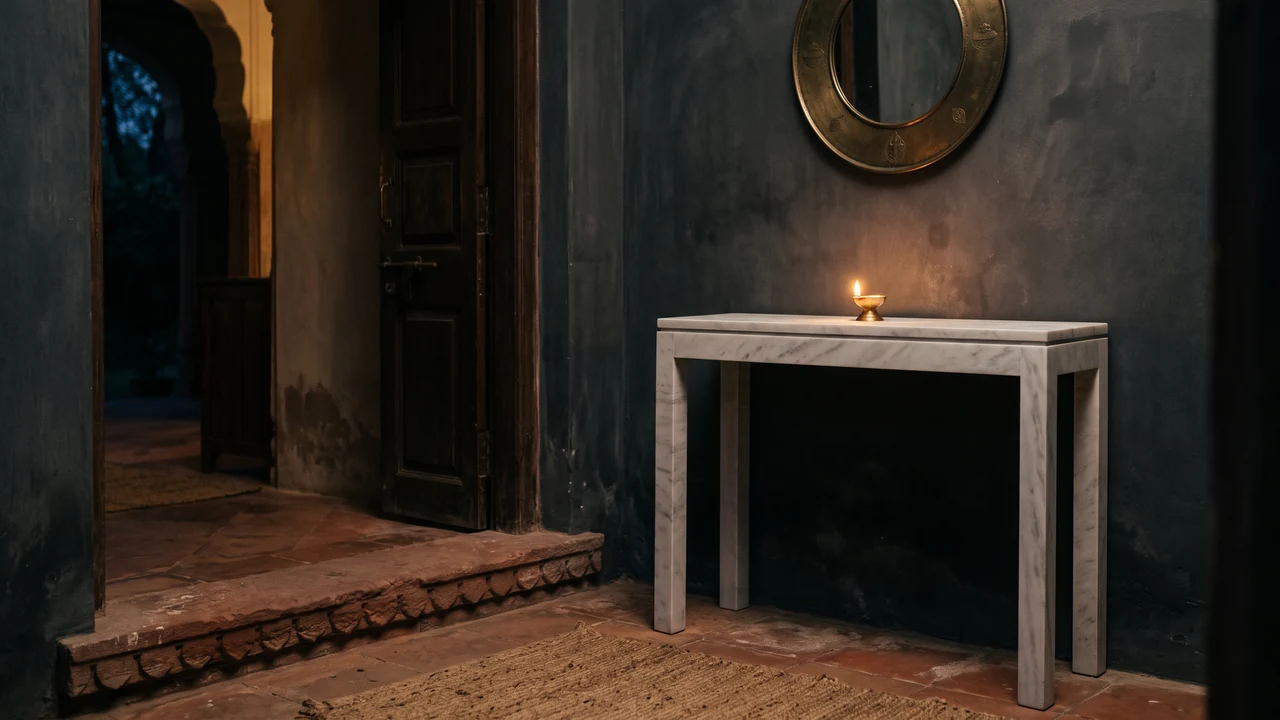
There is a reason a new home in India is not simply moved into but entered. The Griha Pravesh is a ceremony of the doorway — a lamp lit, a threshold crossed, a first step taken with the right foot and full intention. Long before anyone considers the sofa or the bed, the tradition turns its whole attention to the one place where outside becomes inside: the entrance. It knows something worth remembering. The doorway is the first sentence a house speaks, and it is the sentence every guest hears first and every resident hears daily.
This piece is about how to make that sentence a good one — in stone that will still be saying it in fifty years. We will talk about Vastu honestly, about the threshold that modern homes quietly deleted, and about the door and the console that together do the real work of a welcome.
What Vastu actually asks of an entrance
Vastu Shastra is India's oldest framework for building, and beneath the popular checklists it is mostly about three things: direction, light and flow. At the entrance it speaks clearly. The main door — the mukhya dwar — is treated as the mouth of the home, the point through which energy, guests and fortune arrive. North, east and especially the north-east — the sacred Ishan corner tied to morning light and water — are the directions the tradition favours for a doorway. The threshold marks a deliberate boundary. And the space just inside should feel open, uncluttered and welcoming, never dark or blocked.
Strip away the anxiety that often surrounds the subject and what remains is sound design sense: face the light where you can, mark the crossing, and let arrival feel generous. Most of us cannot choose which way our front door faces — that was decided by the builder years ago. Vastu has always known this too, which is why it offers remedies for the entrance you have rather than demanding the one you don't. That leaves the decisions that are genuinely yours: the threshold underfoot, the frame around the door, and the first object a visitor's eye lands on.
Our honest position on Vastu and stone
We should say plainly where we stand, because an atelier that traffics in luck is not one to trust with a lifetime piece. We do not sell auspiciousness. No stone is luckier than another; no colour placed in a corner changes a life; and we will never tell you that a marble console will fix your fortunes. That would be a dishonest use of a serious tradition and of your money.
What we do believe is that meaning and permanence belong together. If a Griha Pravesh matters to your family, then the doorway deserves an object made to outlast the occasion — carved from a single block of Indian stone, honest about how it is built, and beautiful in the specific light of your home. We will happily work within your Vastu intentions, orient a piece the way your family wishes, and help you honour the corner you hold sacred. We simply do it as craftspeople, not astrologers. The result is an entrance that feels considered and blessed because it was made with care — which is, in the end, what the ceremony was always pointing at.
The threshold: the line you cross
Ask an older relative about the dehleez — the umbara, the threshold — and you will hear that it was never just a step. It kept monsoon water and street dust from the home, yes, but it was also the line you crossed with awareness: touched in respect, stepped over rather than on, the seam between the world and the sanctuary. Somewhere in the move to flush modern floors, that line was quietly erased. Most new flats have no threshold at all; you drift in from the corridor without ever arriving.
A carved stone threshold restores the moment without becoming a hazard — a low, smoothed sill in a warm Jodhpur Red Sandstone or a pale marble that says, gently, you are home now. Where a raised step is impractical, the same effect can be built into the frame overhead and the floor's material change underfoot. The point is not the height of the stone; it is that crossing into the house feels, once again, like something you do on purpose.
The portal: framing the doorway
India carved its doorways with more devotion than its walls, and for good reason — the fort-builders of Rajasthan knew the door outlives the house. A stone portal frames the entrance the way a torana once framed a temple's approach, turning a plain opening into an event. Pravesh — the word means "the entrance" — draws on those great fort doors of Bhainslana Black that weighed tonnes yet turned on a fingertip. Toran, in Makrana White Marble, takes its name from the two-thousand-year-old gateways of Sanchi, the arch that has outlasted the dynasty that raised it. Dwara — "the door" — is a full carved portal in Jodhpur Red Sandstone, moulded jambs and all, the way the haveli builders made them.
A portal is a considerable commitment of stone and space, and it belongs to entrances that can carry the drama. But nothing else announces a home the way a carved doorway does — it is the Vastu mukhya dwar given physical, permanent form.
The console: the first piece a guest meets
For most homes, the real entrance decision is smaller and more useful: the console table that sits just inside the door. It is, quite literally, the first piece of furniture a guest meets — the surface for keys and a diya, the mirror's companion, the object that sets the tone of everything behind it. An entrance console earns its place by being beautiful more than by being tough, because the doorway sees admiring eyes far more than it sees spills.
That freedom lets the stone lead. Pravesha in Banswara White — its name, again, "the entrance" — leans on legs like a doorway caught mid-bow, all pale welcome. Madhya in Indian Statuario carries the composure of a throne set on the centre line of a hall. Setu in Jodhpur Red Sandstone distils the royal arch of Marwar into a warm, grounded console for an entrance that wants weight rather than lightness. Any of them, placed where the morning light reaches it, does what Vastu asks of the space just inside the door: it makes arrival feel open, considered and glad.
Choosing the stone for your light
The single most useful thing you can do — more useful than any directional chart — is to notice how light moves through your entrance. A north or east doorway that catches morning sun flatters a pale, luminous marble; a darker or artificially lit hall is often better grounded by a warm sandstone or a deep Bhainslana Black that reads as intentional rather than gloomy. Warm stones make a welcome feel earthy and rooted; cool pale stones make it feel airy and formal. Neither is more correct; they are two different sentences for the house to speak.
If your family observes the north-east as the sacred Ishan corner, that is often where a small mandir or a lamp naturally belongs, and the entrance stone can be chosen to sit in quiet conversation with it. Our guide to choosing a stone walks through the temperament of each material in detail, and the full range is laid out on the materials page — every stone Indian-quarried, each with its own way of holding light.
Because a carved portal or console is genuinely hard to picture from a slab photograph — and because a Griha Pravesh comes with a fixed date you are planning toward — the Visualizer will place a piece in an entrance like yours in under a minute, so you can weigh stone, scale and colour against your own doorway before anything is cut. Every piece here begins the same way ours always have: Imagine It. Visualize It. We Build It.
Imagine It. Visualize It. We Build It.
Planning an entrance for your Griha Pravesh?
Tell us your doorway — its direction, its light, and the welcome you want a guest to feel — and we will help you choose a threshold, portal or console carved from a single block of Indian stone, in time for the day.
Frequently asked questions
Which direction should the main door face according to Vastu?
Vastu tradition favours a main door in the north, east or, most auspiciously, the north-east — the directions associated with morning light and the sacred Ishan corner. In practice most homes cannot choose their entrance direction, and Vastu has always offered remedies for the ones you have. We take that as freeing rather than binding: the direction is usually fixed, so the meaningful decisions left to you are the threshold, the door and the first piece a guest meets — which is exactly where craft, not superstition, does the work.
Does Vastu say which stone or colour to use at the entrance?
Not literally. Vastu speaks in directions, elements and light, and different schools map colours to directions loosely and inconsistently. No stone is "luckier" than another. What the tradition really asks of an entrance — weight, permanence, a clear threshold, a sense of arrival — is answered by any well-chosen natural stone. Pick the stone for how it looks against your light and how it will age over decades, and let it honour whatever Vastu intentions you hold rather than claiming to satisfy a rule.
What is a dehleez, and do modern homes still need one?
The dehleez or umbara is the traditional threshold — the raised sill that marks where outside ends and home begins. It was practical (keeping water and dust out) and symbolic (a line you cross with intention, often touched in respect). Modern flush floors have quietly erased it. A carved stone threshold, or a portal that frames the doorway, restores that moment of arrival without tripping anyone — the meaning survives even where the raised step is only suggested.
What is the best stone for an entrance console in an Indian home?
The entrance is low-traffic for spills but high-traffic for eyes, so beauty leads and daily durability matters less than in a kitchen or bath. A pale marble like Banswara White or Indian Statuario reads as light and welcome; a warm Jodhpur Red Sandstone or Udaipur stone grounds a doorway with earthy weight; Bhainslana Black brings quiet formality. Choose by the light your entrance receives and the mood you want a guest to feel in the first three seconds — the console is the home's opening sentence.
Can the Visualizer help me plan my entrance before Griha Pravesh?
Yes — that is exactly what it is for. A carved portal or console is hard to picture from a slab photograph, and a Griha Pravesh has a fixed date you are planning toward. The Visualizer places a piece in an entrance like yours in under a minute, so you can judge scale, stone and colour against your own doorway long before a block is cut. It is the fastest way to move from "I want the entrance to feel right" to a decision you can commission.